
[The GameDiscoverCo game discovery newsletter is written by ‘how people find your game’ expert & company founder Simon Carless, and is a regular look at how people discover and buy video games in the 2020s.]
G’day, folks, and we’re back. Today’s lead story is on a bigger topic, but one that seems relevant: how long did that hit game take to make, who was behind it, and are they a professional game developer? (The answer is: they are, because they made a hit game!)
Before we start, yes, this is the week of Summer Showcase Season (aka Summer Game Fest, aka ‘not-E3’.) Thus: Steam has a special sale page up, and here’s another list of many of the streaming showcases. (We’ll be measuring the biggest SGF-y reveals later next week, via a newsletter…)
[THE DEEPEST PC/CONSOLE DATA? You can get a free demo of our GameDiscoverCo Pro company-wide ‘Steam deep dive’ & console data by reaching out today - >90 orgs have it. Or, signing up to GDCo Plus gets the rest of this newsletter and Discord access, plus more.]
GDCo news: mecha mecha Meccha Chameleon…
OK, let’s get going here, we’ve got lots of game platform & discovery news to get through:
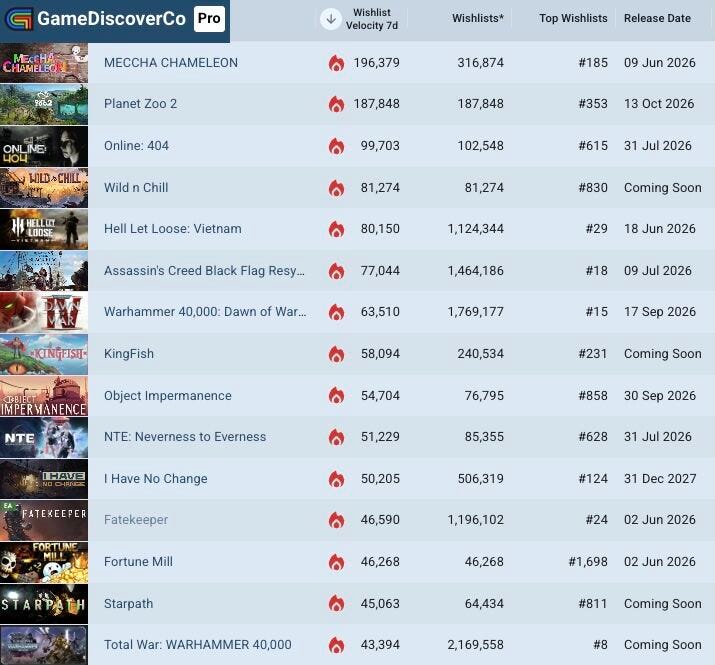
Our latest GDCo Pro 'trending' unreleased Steam games, May 25th to June 1st, sees 'hide and seek where you can paint yourself' title Meccha Chameleon (#1) piling on the wishlists again, as is sim sequel Planet Zoo 2 (#2) and 'survival sim with a smartphone' Online: 404 (#3).
Alongside bigger, returning games like Hell Let Loose: Vietnam (#5) & Assassin's Creed Black Flag Resynced (#6), there’s pixel art 'laid-back wilderness escape' Wild n Chill (#4), clever first-person puzzle game Object Impermanence (#9), incremental game Fortune Mill (#13) and ambitious solo dev spaceship builder Starpath (#14).
ICYMI: Nvidia announced the RTX Spark, Arm-based ‘complete computing chips’ which run Windows PCs and, per The Verge, let you “play the graphically intensive Indiana Jones and the Great Circle at a smooth 100fps at 1440p resolution.” Games are part of the pitch, with anti-cheat coming to Windows on Arm too. (Cost? The first machines, later this year, are “targeting the more premium price points.”)
New site tip: Overworld.vg is a handy news aggregator for games that acts similarly to Techmeme (in the tech space) and Mediagazer (in the media space), by semi-programmatically rolling up multiple outlets talking about the same news.
>$ game consoles? According to Circana’s U.S. retail tracking service: “During the week ending May 16th, 2026, the average selling price (ASP) paid for a new PS5 in the US was $671, as compared to $521 the same week last year (+29%). Xbox Series ASP reached $527 this year versus $433 last year (+22%). Switch 2's ASP was $451.”
Hardcore Xbox fans want to go back in time, and Matt Booty confirming that Xbox Showcase game slates would include multi-platform availability info led to minor social media rioting and Xbox CEO Asha Sharma saying: “It was a miss, and I own it.” But was it? (There’s a lot of stakeholders to satisfy on the Interwebs…)
It’s good that Steam doesn’t allow on-platform search ads! Why? Just check out the result of a recent second ‘sponsored result’ on the iOS App Store: “The ads themselves still work well. The problem is that many of these paid downloads seem to be users I previously would have acquired organically.”
Slay The Spire 2’s multiple ‘review bombs’ in China got better explained by this Kotaku piece, transcribing a top Chinese player roundtable: “Top-level players and streamers from other countries don’t use save loading - or, as they would refer to it, save scumming. This… explains exactly why players in China did not like the Doormaker fight.”
Bloomberg has a high-level overview of Steam as a ‘monopolist’, notable for off-the-record comments from a former employee of “brief discussions about exempting [platform cut from] games with less than $1 million of cumulative sales” that were rejected. (We’re still pitching a <30% cut on the lower end, though…)
No, console devs, bad: PlayStation is removing another prolific ‘easy Platinum’ shovelware dev, and seems more attuned to keyword-squatting games. But not Nintendo, which proudly offered up Dead Gears - Space Of War in the eShop last week. (Limiting Switch 2 devkits doesn’t stop Switch 1 game misbehavior…)
Microlinks: Discord has started social SDK integrations with Roblox games such as Steal a Brainrot & Brookhaven RP; HowToMarketAGame has a new Steam wishlist annotator tool (explainer) for pretty screenshots; Summer Game Fest is featuring Player.gg as a multi-platform discovery platform.
OUR SPONSOR: organic influencer marketing made easy
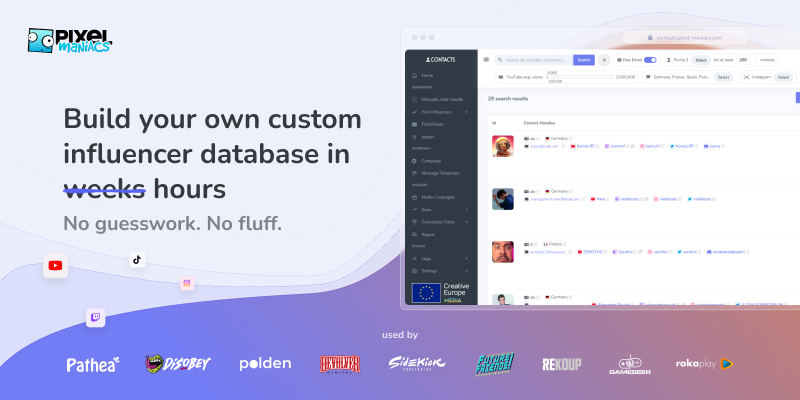
Hours spent on creator research, preparing outreach lists and messaging, and tracking game keys and media coverage. Doing organic influencer discovery and outreach is challenging. Asking creators to cover your game organically will always be a long shot.
Here’s how our influencer tool can help:
- Automatically build your creator database based on similar games.
- Upload keys for every regional platform.
- Filter and export outreach lists based on your creator requirements.
- Share media coverage reports and outreach campaign data
Join other industry professionals doing organic creator outreach right. Write Dennis an email or on LinkedIn to request a demo.
Why ‘hobbyists’ are a bigger disruptor than AI…
Perhaps you are not paying attention to the world of train simulators, unless you’re a secret Francis Bourgeois fan. But the launch of Running Train ($20), a weirdly named (we knowww!) Japanese train sim on Steam, gives us a chance to talk about our thesis: it’s hobbyist/semi-pro game creators that are the main PC market disruptor, not AI…
Not that we think AI is inconsequential: for one, it equips programmers with tools to create games way faster thanks to tools like Claude Code. (And even allows non-programmers to make games more easily.) But our general point here - it’s not about ‘AI making games’, for us, it’s about skilled individuals making games in their niche.
And what’s fascinating about Running Train, which is powered by Unreal Engine 5 and looks gorgeous, is that it was created by a solo Indonesian developer, Rizky Nova, who’s clearly not got any funding - a recent Tweet notes he only has 16GB ram on his machine, and his “first [Steam] paycheck definitely goes straight to PC upgrade.”
We’re estimating this game at 34,000 copies sold and $550k gross already, and that’s after just 10 days in Steam Early Access. The $ may be a bit front-loaded due to the fanbase, but its gorgeous Japanese visuals may be attracting non-train sim fans too.
This type of success just wouldn’t have been possible 10-20 years ago. And here’s what we think changed:
Availability of comprehensive, inexpensive engine tech: most top game teams are using Unreal or Unity to make games. Running Train is using the same tech too, and Unreal’s free to use, with a 5% royalty at >$1m. (Level playing field!)
Asset stores allow massive amounts of pre-created assets: browsing on Fab.com, you’ll see modular Japanese town houses & a host of UE-compatible assets, cheap. ($30!) We’re sure this game’s got many custom assets, but there’s so much to use.
Ability to market to niches: the game had 28,000 wishlists at its Steam launch. Its Twitter account has been live since 2017 tho, and a Patreon with access to the Alpha gave players access since 2023. (Again: anyone can market like this.)
Immediate, global reach via distribution platforms: there’s no inherent advantage to being a large company launching a game on Steam vs. a tiny solo dev, by and large. If you get momentum, you’ll get extra algo recommendation.
Maybe this is all incredibly self-evident. But sometimes I feel like people who’ve been professionally in the game industry don’t see - or acknowledge - the increasing dissolving of lines. We had a Q in the GDCo Pro/Plus Discord recently about working out success rate of ‘serious teams’, discounting for hobbyists or ‘shovelware’.
My comment was that it’s not possible, because “the entire point is that hobbyist games and non-hobbyist games have merged in ways it's not possible to disentangle.” I have the same point when considering Hushcrasher’s innovative work on game budgeting, which I think has a lot of good indicators in it, but runs into these issues too…
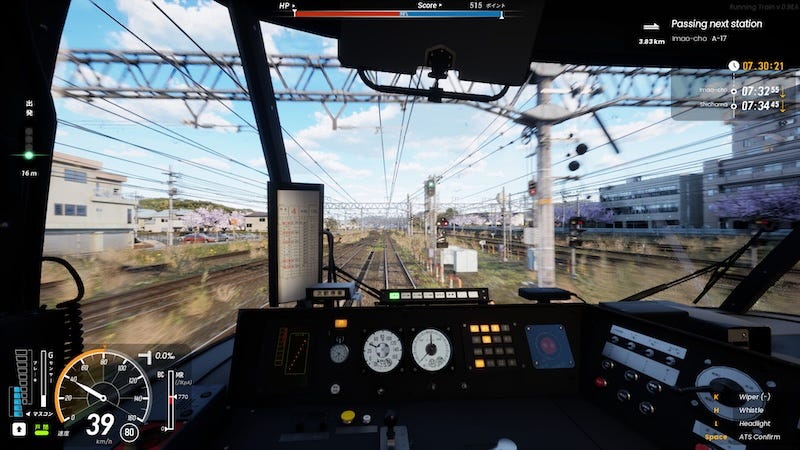
So yes: this is a very specific niche. Though the behemoth in this space, the Train Sim World franchise, which has infinite DLC & also stuttering issues, is being knocked by the fact this game is running so smoothly, apparently by being conservative on UE5 features to work with low-end hardware and optimizing for a v.limited set of tracks.
But the point is: these type of ‘hobbyist/semi-pro makes a breakout title’ is happening quietly everywhere, in almost all genres. A great example we often cite is Dinkum ($23m LTD Steam gross revenue), which a Steam reviewer describes as: “like Animal Crossing and Stardew Valley had a baby and sent it to live in Australia.”
If you look at interviews with its creator James Bendon, who has since signed a deal with Krafton to expand the IP, he notes: “I was a hobbyist… my wife supported me for 5 years, while I pursued this pipe dream.” And the game looks and plays very competitively.
Then there’s huge solo breakouts like Balatro or Schedule I, which are by no means reproducable, but show the sheer amount of competitive material entering the funnel to be sorted and recommended by our clients - people who actually play video games.
So, while I see AI as potentially speeding ‘route to market’ for devs, here’s our general takeaways from the success of games like Running Train, which is much more about the rise of ‘everybody making games’ and how you compete vs. hobbyists:
In the genre you’re building in, do you have expertise advantage? Deep knowledge of genres are a key differentiator (esp. in strategy & sim games!)
How easily could the game you’re making be created by a solo dev? If it’s very straightforward, there will be a LOT of hobbyists, semi-pros & pros doing it.
Do you have a scale differentiator, if you’re making a game at scale? If you’re putting out Blood Of Dawnwalker, the $ is visible onscreen, and people respond. But if you’re spending and people can’t tell vs. hobbyists: it’s a big issue.
In many ways, Running Train is an outlier. We wouldn’t have expected somebody to have optimized this good-looking a (non-collidable!) environment for low specs on Unreal Engine 5, and also roll out a good quality train simulator, 100% solo.
But in a world that’s increasingly outlier-driven, and anyone can publish on Steam if they pay $100, we keep saying ‘we didn’t expect this!’ And with the barrier to entry this low, it’s going to keep happening. So we all need to sharpen up, build our own communities, and get laser focused: otherwise we’re building our games for nobody.
[And literally as we were finishing up this newsletter, the rock steady compilation I was playing decided to cue up Train To Ska-Thedral. Tooot - that’s enough trains for today.]
Top streamed, May: LoL, Subnautica 2 do good…
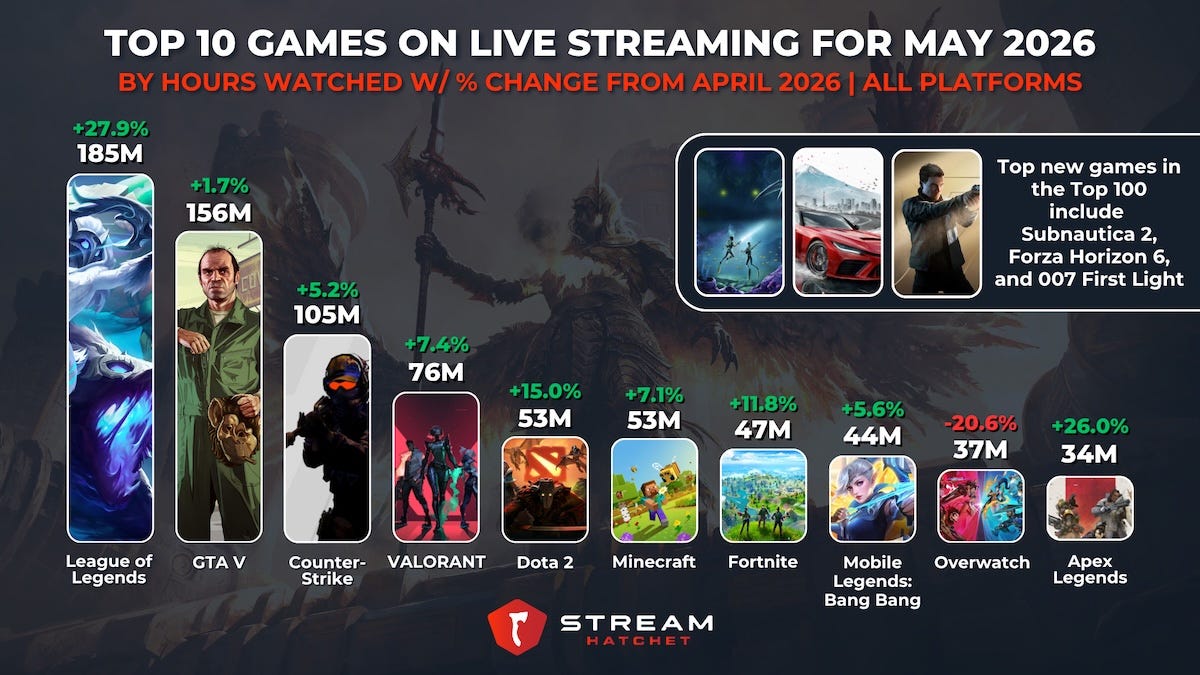
Ending up, here’s the newest data via livestream analytics platform Stream Hatchet, bringing the Top 100 most-streamed games for May 2026 across the big (non-China) game video streaming platforms like Twitch & other medium/small platforms.
And here’s the full list of May’s Top 100 (Google Drive link) with GDCo notes. Once more, Stream Hatchet’s Mark Rowland joins us on commentary to check trends:
League of Legends moved into the #1 spot with a big jump of 27.9%: 16 out of the Top 20 games had more viewers, but LoL in particular hit 185 million hours watched. This includes LCK Cup 2026 coverage among Korean streamers which has seen Chzzk rivaling Twitch’s daily viewership for the game.
Apex Legends peeked into the Top 10 for the first time in over 2 years: it hit a 26% lift to 34m hours watched. Why? Well... it’s giant (and controversial) streamer TheBurntPeanut again. Last month he put Rust into the Top 10, and this month it’s Apex.
For new games, Subnautica 2 and Forza Horizon 6 both made the Top 20: you’ll see them in Friday’s GDCo charts for May. So it’s not surprising these two hit #17 and #18 respectively, both with between 22 and 23 million hours watched.
Also notable? A surprise appearance here by Path of Exile 2 which hit #19, with 19 million hours watched. The reason, 18 months after a really great launch: a huge update called Return of the Ancients, also paired with a F2P weekend and a Twitch Drops event.
There’s plenty of other new titles in the Top 100, too, including late-in-month release 007: First Light (#26), as well as Gamble With Your Friends (#57), the new LEGO Batman game (#60), plus creepy horror title Directive 8020 (#69). Toodles…
[We’re GameDiscoverCo, an analysis firm based around one simple issue: how do players find, buy and enjoy your PC or console game? We run the newsletter you’re reading, and provide real-time data services for publishers, funds, and other smart game industry folks.]