[The GameDiscoverCo game discovery newsletter is written by ‘how people find your game’ expert & company founder Simon Carless, and is a regular look at how people discover and buy video games in the 2020s.]
As GDC finishes up, we’re back to the text mines. Our verdict on GDC 2026? Great weather, good experiential show setup, & enthusiastic vibes from attendees (U.S., Asia, not so much European, & a tad student-first.) But it’s a deal-light environment (unless you wanted to meet Mario and talk MGs), as bootstrapped, agile hits continue to provide the only major ROI, outside of a chunk of outlying AA/AAA games.
Before we start, a shout-out to board game publisher Stonemaier Games, who do that ‘transparent sales #s’ thing we love. Their 2025 stakeholder report shows $23.7m in revenue and LTD sales of 2.64m units for their big hit, Wingspan, with its 2024 spinoff Wyrmspan at 450k. (It’s all about franchises, right? Tho Scythe also hit 600k units.)
[FREE DEMO OF GDCo PRO? You too can get a gratis demo of our GameDiscoverCo Pro company-wide ‘Steam deep dive’ & console data by contacting us today - ~90 orgs have it. Or, signing up to GDCo Plus gets the rest of this newsletter and Discord access, plus more. ]
Game discovery news: Pokopia, Res Evil still shine!
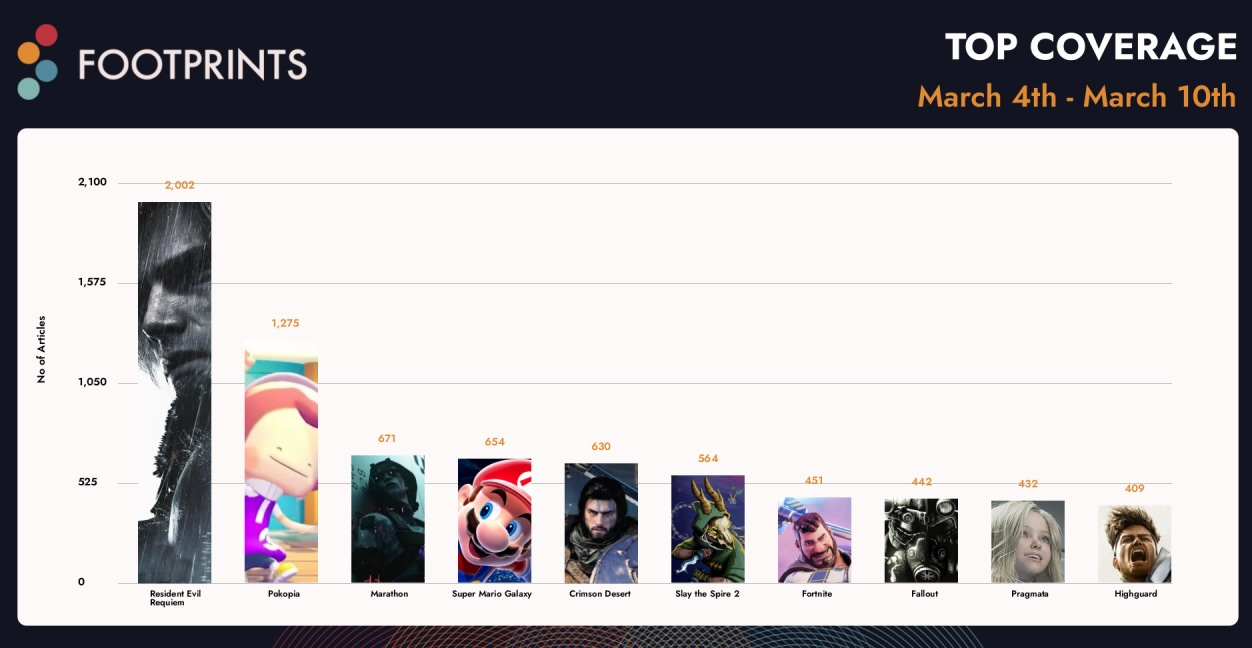
And let’s finish off the week by cramming in a bunch of the rest of GDC news - we have some left over for next Tuesday, though:
The latest Footprints.gg estimates on weekly ‘trad media’ mentions show Resident Evil Requiem at #1 yet again, but the Pokemon life sim Pokopia a very strong #2 - it confirmed 2.2m copies sold already. Also notable: Marathon, the lurking, about-to-hit Crimson Desert & the still supreme Slay The Spire 2.
Super interesting? Valve sent a comment to its New York-based players about the loot/mystery box lawsuit from that U.S. state. Read it carefully - it reveals that “the NYAG seems to believe boxes and their contents should not be transferable”, which goes against Valve’s ethos, and also pushes back against more player tracking.
Also appreciate Valve’s shout-out to the ‘game shaming’ side-quest of the suit we also hated: “We feel the need to address comments made by the NYAG about games, real world violence, and children. Those extraneous comments are a distraction and a mischaracterization we’ve all heard before.” Amen.
Discord is now letting developers customize the profile for their game, Discord-wide. Pre-requisites? “Your dev studio must have a (soon-to-be-verified) Discord server… your game must be on Steam, and the Steam store page must link to your Discord server… your game must be playable, meaning it’s available for download and play.”
Epic announced that Fortnite is raising prices, since “the cost of running Fortnite has gone up a lot and we’re raising prices to help pay the bills”, with 80-92% of the vBucks now buyable for the same price. (Purchases still come with 20% back in Epic Rewards, cross-spendable on Epic Games Store - is that promo permanent?)
European ratings agency PEGI just switched things up: “four new categories… will.. tackle elements of addictive design in games, unmonitored online communication, and - the big one - paid content in a game including systems like loot boxes.” This means a game like EA Sports FC, normally PEGI 3, “will now likely be age-rated PEGI 16.”
Xbox’s Jason Ronald talk at GDC was notably beefy, with its next-gen Project Helix a big source of discussion: “The next-gen Xbox plays Xbox console games and PC games… Alpha versions of Project Helix will be sent to developers in 2027.” (With current hardware shortages, it’s gotta be non-cheap and dated for ‘later’, though.)
Also notable from that keynote: “Ronald announces ‘Xbox Mode’ is coming to Windows 11 in ‘select markets’ starting in April. It adds features found on Xbox Ally to your PC and laptop. You'll be able to switch into Xbox mode to get that ‘Xbox feeling,’ Ronald says.” So multiplatform goodness, even as ‘This Is An Xbox’ gets erased?
Looking at Nvidia’s GDC announcements, of which there are many, here’s one that stood out: “GeForce NOW users, from March 19th, can play at up to 90 FPS on virtual reality headsets, including the Apple Vision Pro and Meta Quest.” (And it’s their GTC event next week, although we imagine that’ll be AI-first, hah.)
In ‘not the usual suspects are making great $ on games’ news, Bloomberg looks at some of the Roblox creators that have prospered recently: “Between homework and a part-time job at a Chinese restaurant, Colley invented Fisch… today, at 19, he’s collecting $400,000 a month for his creation.” (Many do so by partnering with ‘scalers’.)
AI in games? Google’s DeepMind talk at GDC (per Stephen Totilo, $) explains: “Genie 3… has memory limits before the consistency of its worlds break down. It can remember.. pretty well for about a minute.” And per Circana: “US video game player sentiment around the use of generative AI is worsening” - 25% would skip if AI-ed.
Microlinks: how Bioneers “reached 26,000 Steam wishlists in 5 months with no marketing budget for our upcoming Factorio-style simulation game about biology”; Save the World, Fortnite's original PVE survival mode, is finally going free-to-play after almost nine years; Valve sued by the UK’s Performing Right Society over licenses for in-game music on Steam.
What Steam’s 2026 biz update tells us about the ecosystem
Having got done with GDC, it was Valve’s presentation on ‘the state of Steam in 2026’, given both offsite and onsite at GDC, which we made a beeline for. These annual talks aren’t known for big reveals. But they do provide great context into how our atypical PC game distribution daddy looks after its rapidly multiplying children (that’s you?)
There was an ‘assets’ page given out by QR code at the end of Valve’s GDC talks, which gives you a good idea of the kind of thing discussed via links. (A separate Steam hardware talk does have a slide deck, but it’s a bit contextless. And the deck for the Annual Update would have been even more so, hence not being shared.)
But since we were there, here’s an impression of what Valve’s Kaci Aitchison Boyle and Tom Giardino said - besides a good Tom G. joke on the state of Valve’s hardware push: “If you have a line on a bunch of RAM, we would love to buy it from you!” Here’s what was interesting about the talk:
There was a deliberate shift towards explaining how Valve thinks: rather than a list of new features, they wanted to go into how and why they make decisions. For example: Daily Deal improvements, where 1,500 games got Daily Deals in 2025, 69% never featured before, with $ from Daily Deals being up 274% year on year.
How Valve thinks - they want to try to get out of the way: in the Daily Deal example, the duo also discussed things that they didn’t do - start scheduling pre-planning programs, charge money for featuring, or “become tastemakers” and pick the games themselves. They felt ‘self-serve’ was way more powerful.
As a privately held, long-term focused company, their priorities are different: for Valve, it’s all about two things, players and developers, they say. Thus: no ads on platform, and as Tom claimed, not a company where “decisions are made around quarterly earnings calls… sometimes incenting decisions that aren’t good for the product.”
All of this is intriguing because, well, it feels to me like Steam hasn’t always tried to explain its ethos so clearly. At one point, Kaci said that “we really make decisions based on ‘exactly what your happiness is looking like’”. And I think they do try. And in many ways, the libertarian-adjacent Valve is oddly ‘pure of heart’ and selfless. (With some rich megabosses with superyachts, background playing up income inequality, ofc.)
Anyhow, the deliberate process the duo outlined of shipping a solution, getting feedback and iterating is frankly a joy, compared to many other platforms who don’t even have a clear input process for changes. And the pace of improvements to the platform in 2025 is pretty impressive.
GameDeveloper.com’s Chris Kerr has a write-up of the talk (and some live-BlueSky-ed pics), with a few more details, including Tom G. noting that Steam usage is roughly “double the peak concurrent and in-game users from five years ago.” (We do think that revenue on Steam has been up double digits almost every year in that time.)
More games doing better on Steam - that’s good?
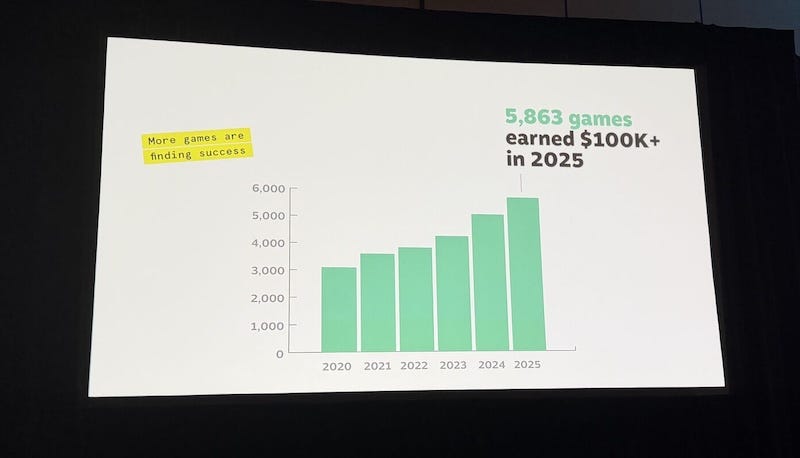
But look, I know many of you reading don’t feel so great about what’s going on. In 2026, platforms are regularly punching bags for the people that develop or publish on them. Why? Because their new game isn’t successful or profitable. Which sucks.
Which is why two transparent, data-specific slides from Valve’s talk already caused a ruckus on the Internet. The first one (my pic, above) reveals that 5,863 Steam games earned >$100k USD in 2025, almost double the total for 2020.
And the second one (below) is a similar stat for games grossing >$500k USD in 2025. There were 2,395 of them, and again, that’s almost double the pace of $500k-grossers in 2020. Tom’s point was that “dramatically more games finding success every single year”, and such increases are “generally keeping pace” with user growth.
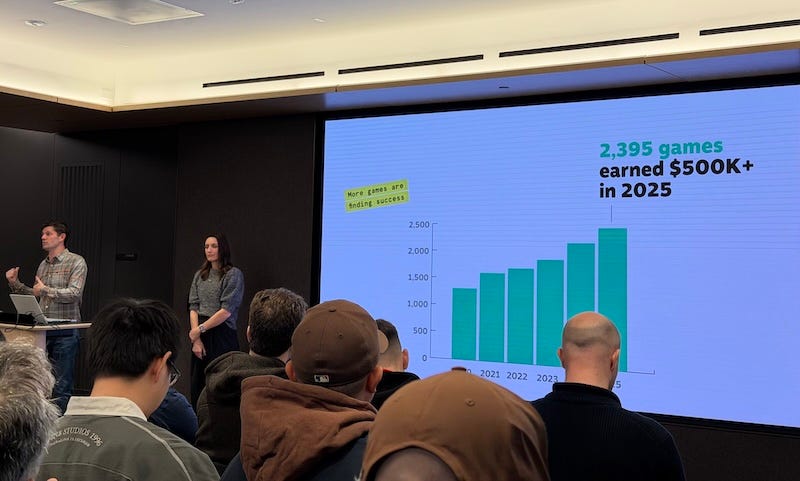
Are people happy about increased success, though? No, they are not. And the #1 complaint is that these estimates included games released in any year, and says nothing about how new games fared. Some people even think the graph is in some way deceptive.
This is actually super-interesting because Valve’s choice of graph reflects how they think of the ecosystem. The Steam algorithm doesn’t have significant bias towards the age of the game (and with many great games being updated for a long time after release, I’d argue that it probably shouldn’t.) So for them - line go up, good?
[There’s maybe a weird meta-discussion to be had about that: for example, is the fact that older games are equally favored by the Steam algo actually a curation decision? Please discuss this at your next grad lecture - we don’t really think so.]
Anyhow, we made it easy for everyone, and we used GameDiscoverCo data to estimate what we think the release year of games in Valve’s graphs were. It won’t be perfect, but it’s good enough. And here you go:
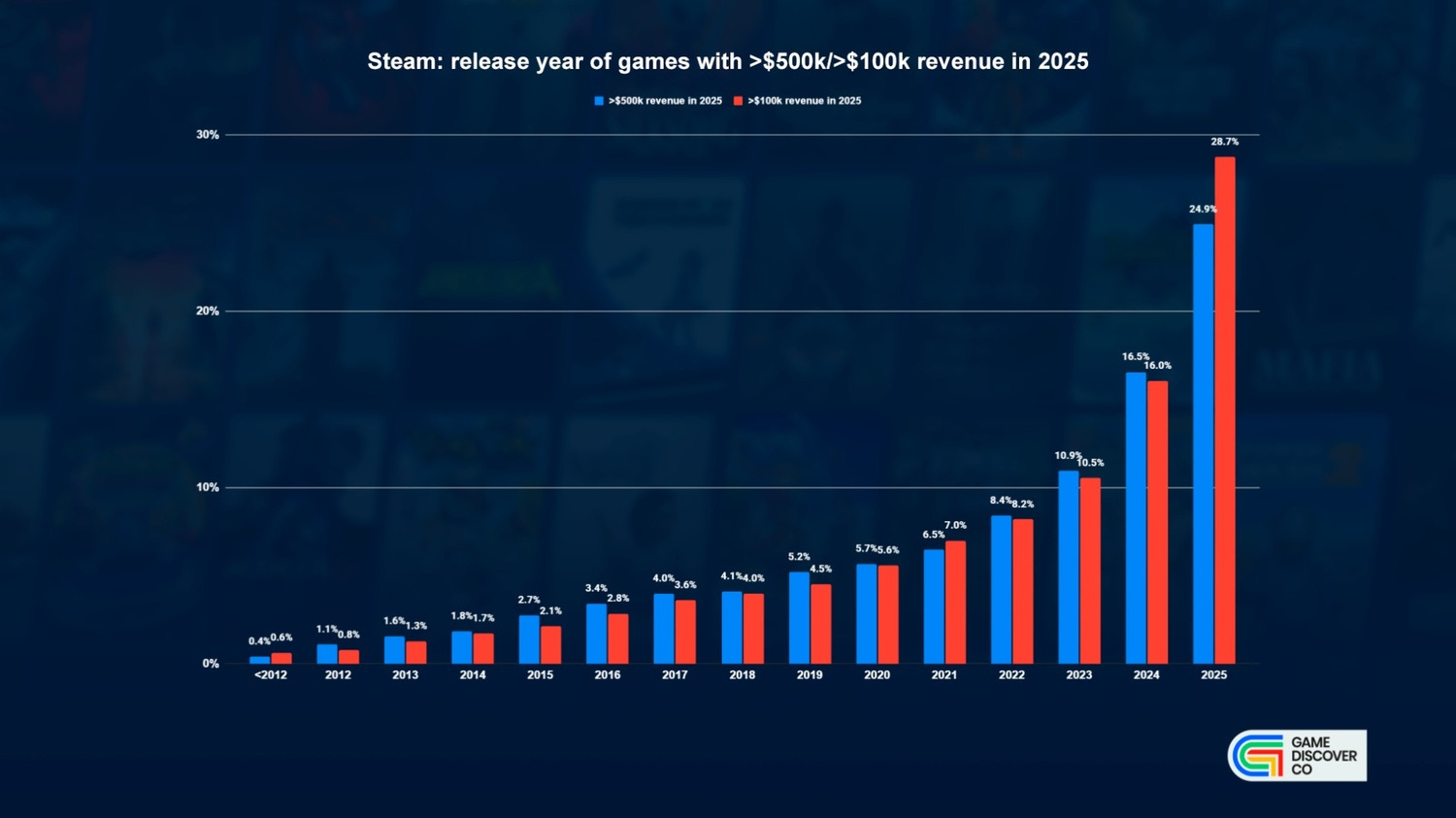
So your answer is - about 25-30% of the games in those charts were released in 2025, and the rest earlier - in some cases much earlier. Some swift extra math(s) on this, including year on year comparisons:
For >$100k games: in 2025, 29% of the ~5,800 games = ~1,700 were released in 2025. (That’s 8.5% of all 20k games released in 2025.) In 2024, it was 24.2% of ~5,300 games = ~1,300 released in 2024. (That’s 7% of the 18,500 new games in 2024.)
For >$500k games: in 2025, 25% of the ~2400 games = ~600 were released in 2025. (That’s 3% of all 20k games released in 2025.) In 2024, it was 21.6% of ~2,100 games = ~460 released in 2024. (That’s 2.5% of the 18,500 new games in 2024.)
If you can even read all the stats above without your eyes crossing, it means that Valve could have done a similar graph for new games, showing good year on year increases (at least from 2024 to 2025), and even the % of new >$100k & >$500k games going up YoY. That’s… good, right?
So why are individuals ‘steamed’? It’s really about ‘everyone making great games’ - the democratization of game dev. Open platforms encourage bootstrapped indies like Buggos 2 or Monster Care Simulator (plucking from the ‘>$100k in 2025’ list) that are great, but made by 1-2 individuals, not created by the usual suspects in offices. It’s - in our view - a lot of these titles that are supplanting bigger, more organized efforts.
For some devs, it may have been that 2015-2020 on Steam was operating on ‘easy mode’. You could make a decent game and it sold - less choice, less catalog backlog. (We think there was a bigger gap from ‘pro games’ to ‘non-pro games’ back then, too, anecdotally.) Now you can make a 2017-era ‘decent game’, and it can sell <1k units.
Coincidentally, Paul Kilduff-Taylor just put out an op-ed about these very graphs, in which he notes the ‘Indiepocalyse’ panic has been around for at least a decade, and he concludes: “What changes are we supposed to make based on this information? Trim budgets even further? Give up entirely? Personally, my career has been impeded much more significantly by pessimism and anxiety than by material market conditions.”
So you need to understand the environment you’re making games in. But two final pieces of contrasting advice, based on what we see: sure, listen to Kenny Rogers when he says ‘know when to walk away’, but otherwise, well, ‘Keep Calm And Carry On’.
This week on Steam: Monster Hunter Stories, hey!