
[The GameDiscoverCo game discovery newsletter is written by ‘how people find your game’ expert & company founder Simon Carless, and is a regular look at how people discover and buy video games in the 2020s.]
It’s the week after GDC, then, and the show’s 20,000 attendees from 85 countries (down from nearly 30k, with the Expo Pass - and a bunch of the expo - missing) is around where we expected. We still want to know the step count of the Dots.eco unauthorized giraffe, tho, who was shimmying all week like an ungulate possessed.
Before we start, this v.entertaining The Verge podcast with Hasbro CEO Chris Cocks - who seems smart, actually - did include this gem of a quote about toy testing scales: “We did carefully avoid saying six-seven around little kids in any play test labs. I think we purposely capped our rating scale at one to five and not 1 to 10.” (He’s joking, but hey…)
[BETTER ACCESS TO DATA? You too can get a free demo of our GameDiscoverCo Pro company-wide ‘Steam deep dive’ & console data by reaching out today - ~90 orgs have it. Or, signing up to GDCo Plus gets the rest of this newsletter and Discord access, plus more. ]
Game discovery news: Crimson Desert is here…
Let’s start out with a look at - frankly voluminous - game platform & discovery news, some left over from GDC:
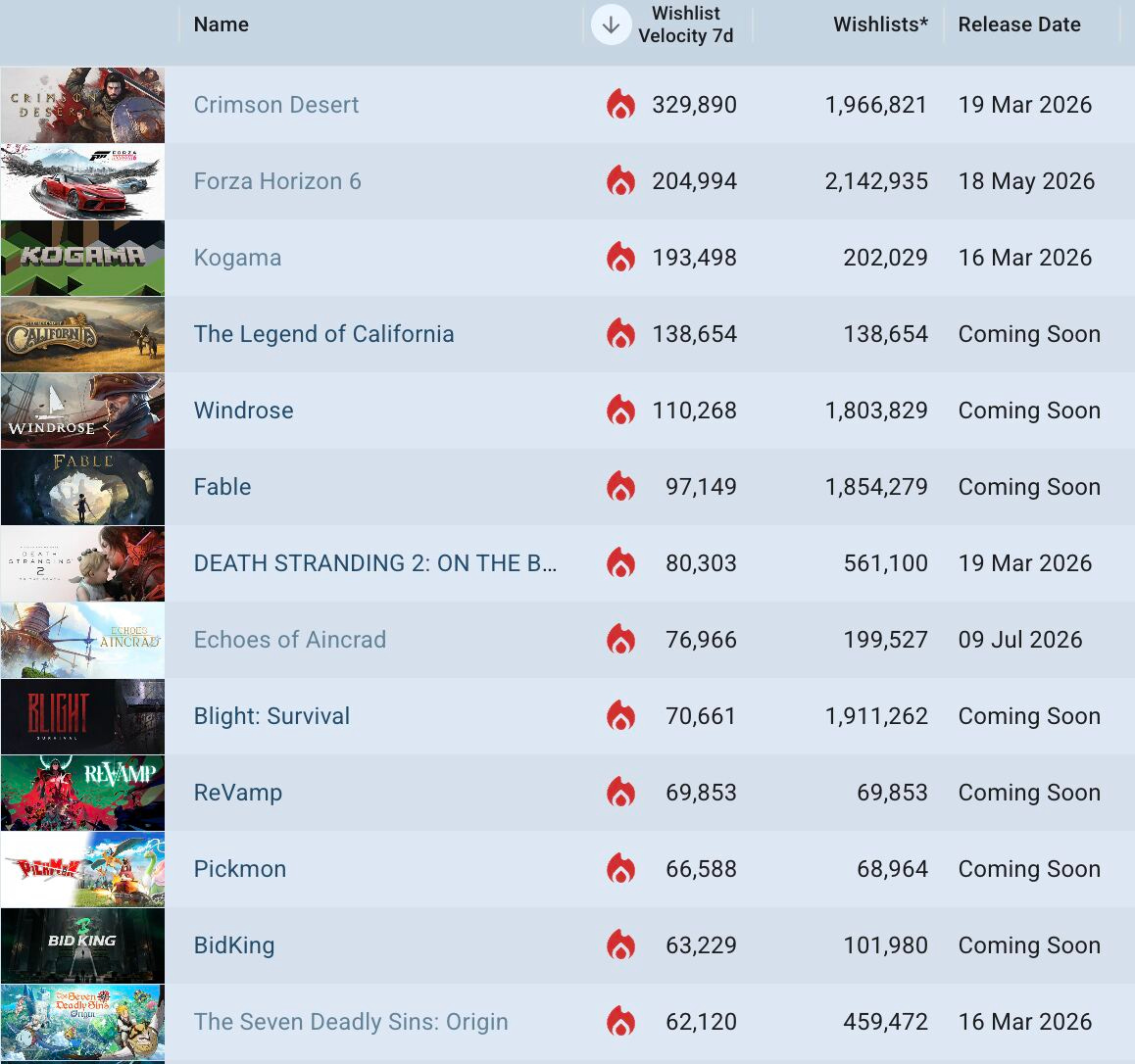
The latest unreleased trending Steam games, according to GDCo Pro's 7-day wishlist charts (March 9th-16th), are headed by Pearl Abyss' epic open-world ARPG Crimson Desert (#1), which is heading for a giant multi-platform debut. Also repeated winners: Forza Horizon 6 (#2), and the piratical Windrose (#5).
New announcements? Open-world ‘alt Gold Rush’ title The Legend Of California (#4) looks hot, as does Digital Sun’s castle-defense roguelite where you play Dracula, ReVamp (#10). (And Kogama, once at #3, got announced & swiftly delisted cos it was using a pirated version of the Minecraft source code. Huh.)
Nvidia’s latest “real-time neural rendering model that infuses pixels with photoreal lighting and materials”, DLSS 5, got announced at GTC, and is either incredibly impressive, according to Digital Foundry, or a ‘yassify’ simulator, for those who aren’t impressed with AI. (Take yr pick!)
Last week’s awards shows at GDC saw upcoming ‘surreal strategy game’ Titanium Court pick up the Grand Prize in the Independent Games Festival awards, as “Clair Obscur: Expedition 33 won five categories, including Game of the Year” at the Game Developers Choice Awards, with Blue Prince getting the Best Design nod.
Steam’s official top releases for Feb. 2026 - by revenue tier - are here, and we talked about most of the top titles already. But DLC is included, which we didn’t - this Age Of Empires II x South America DLC charted in Silver tier, as did an Age Of Mythology expansion pass and Battlefield 6 & Call Of Duty add-ons.
Microlinks: Valve detail Steam Frame and Steam Machine Verified requirements at GDC 2026; Epic Games Store on mobile is “having a tougher time than expected breaking Apple and Google’s store duopoly”; Apple has reduced its App Store royalty from 30% to 25% in China, partly due to regulator pressure.
Streaming showcases last week? The Future Games Show’s spring showcase was the big one (full set of announcements), inc. a Deep Rock Galactic: Rogue Core release date in May. But the much weirder Computer Worlds showcase - “a new showcase celebrating strange & distinctive games” - was also super cool, if niche-ier.
Steam things: Valve’s got the FBI to take Steam game malware hijacks seriously, hence a page to report being targeted by them - Qs indicate the thieves were after crypto; Valve is facing another lawsuit over its loot box system, this time a U.S. class action suit over Counter-Strike 2 and pseudo-gambling.
Google’s getting more aggressive with the PC version of Google Play Games, as Ars Technica notes: “The company promises its store will have more Windows titles, make those games easier to find, and help bring Android experiences to PCs (and vice versa).” More premium PC games on the subscription service sounds like a plan…
We recently talked about Nintendo’s slower Switch 2 SKU approvals, and New Blood's Dave Oshry notes: “We're waiting for Nintendo to give us approval to actually launch [a 120FPS mouse-controlled Dusk on Switch 2] because they're still pretty cagey.” (We agree with Dave that they’re protecting against Switch 1-like “slop fests”.)
Microlinks: a look inside the horror gaming streamer landscape, post-Res Evil launch; Apple’s adding Dredge - with all DLC content so far - and Unpacking to Apple Arcade in April; Clair Obscur: Expedition 33 leads UK BAFTA Games Awards nominations.
OUR SPONSOR: FirstLook.gg: Get Better Player Signals
GDC 2026 was a vibe, but the 'pre-launch anxiety' was too real. Everyone is tired of guessing if their game is gonna hit.
FirstLook gives studios structured playtesting infrastructure: recruitment, surveys, sentiment analysis, and reporting, all in one place.
Game engine usage on PC: the last 10 years?
Since we just added game engine & tech scanning for over 33,000 Steam games (and counting!) for our GameDiscoverCo Pro service, we thought now would be a great time to show you what we’ve found out. (As noted before, we adapted SteamDB-created tech to do this - all hail xPaw, and support him on Github.)
But why start this analysis with a Brotato trailer? Well, according to our file structure tracking analysis across a wide range of games, it’s the highest Steam revenue title ever created in up-and-coming open source game engine Godot:
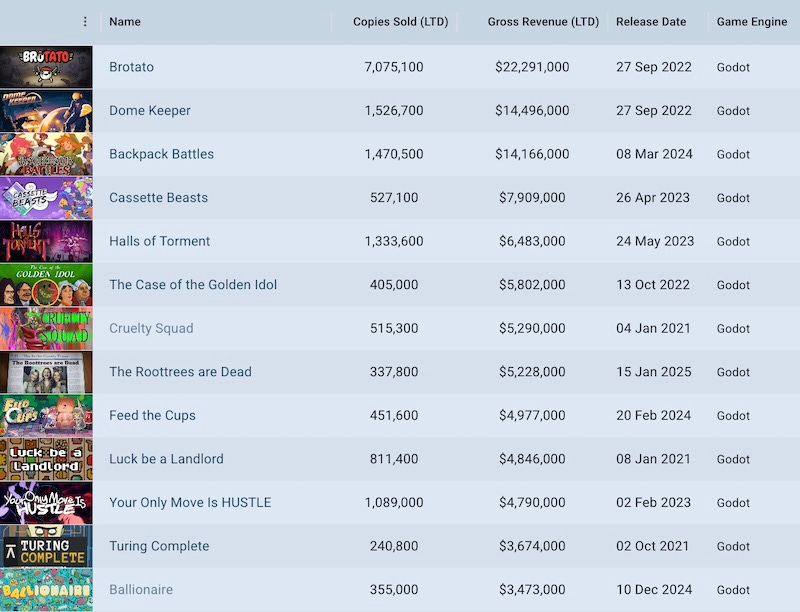
[EDIT: after feedback, we need to add Slay The Spire 2, which we didn’t get to scanning just yet, and Buckshot Roulette, which is configured differently to our file scanner, to this list!]
It’s actually interesting to examine the earthy indie vibe of these titles, from Backpack Battles to The Roottrees Are Dead & beyond, and that’s actually ~$100m in gross Steam revenue between these ‘small’ games.
Overall, Godot is getting big for game jams - 39% of the GMTK Jam games in 2025 used it, up from 13% in 2021. But we wondered how it was faring in sheer numbers against Unity & Unreal, indisputably the ‘big 3’ of game engines that ‘regular’ devs use to make games nowadays. And that’s just what this chart shows:
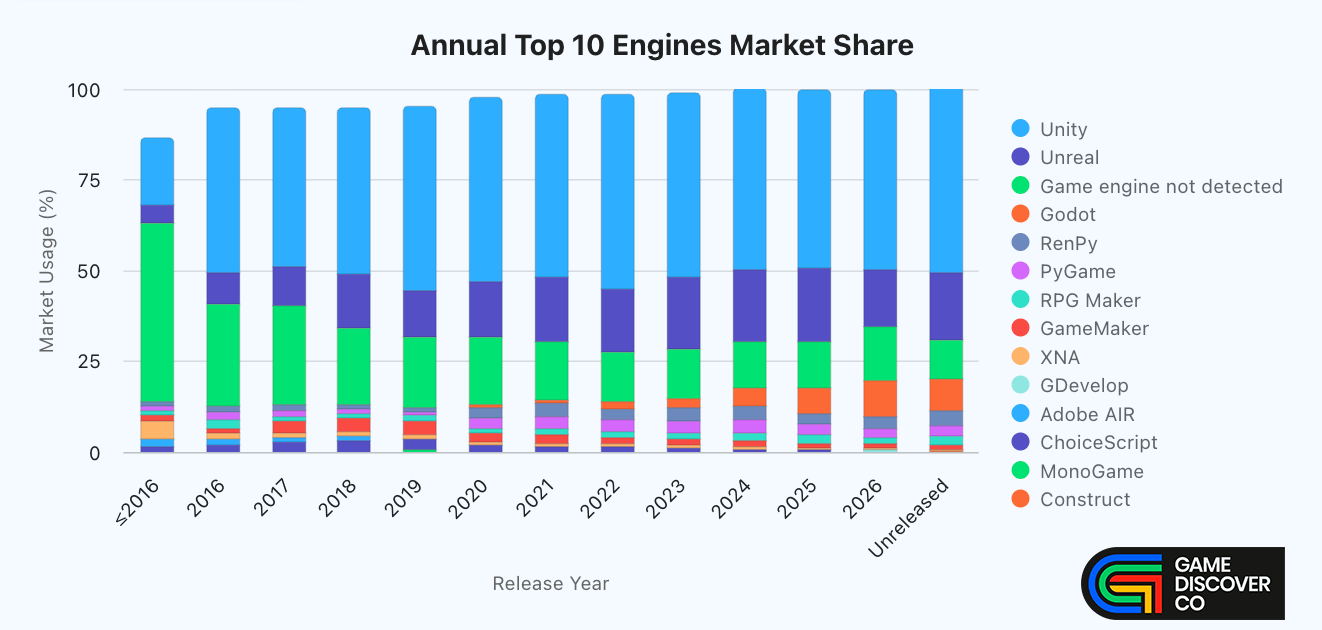
This data is purely based on sheer number of games released, and it’s interesting for a couple of reasons:
Godot has seen a significant market share uptick in recent years: it’s up from 0.9% of all the games we scanned in 2020 to 7.1% in 2025, the last full year we captured. And it’s 8.6% of all unreleased games we scanned. (Godot console is still a little messy, btw, since you probably need to use third-party middleware ports.)
But that increase hasn’t come at the expense of Unity or Unreal: despite some business model woes at times, Unity has regularly had 50-51% of the total share of released games, dipping sliiightly to 49.4% by 2025. And Unreal is somewhat on the up, from 15% in 2020 to ~20% in 2025. (More like ~18.5% for unreleased games.)
What’s been fading? The ‘roll your own engine’ approach: there are so many things to worry about, and engines got so cheap and good, so why make your own? (Many engines have packed Asset Stores with entire game templates in them, too!) Thus, ‘no obvious game engine’ is down from 27% in 2017 to 13% in 2025.
There’s some other smaller trends at play. For example, it looks like GameMaker lost ~2% of total market share in the last few years, we suspect mainly to Godot. Overall, our sample isn’t perfect, but it comprises all games with >$500k lifetime revenue on Steam, plus thousands of others, plus all games that are free or have a free demo.
So we can do things like ‘show me Steam game market share by # of games for all titles that made >$500k lifetime’:
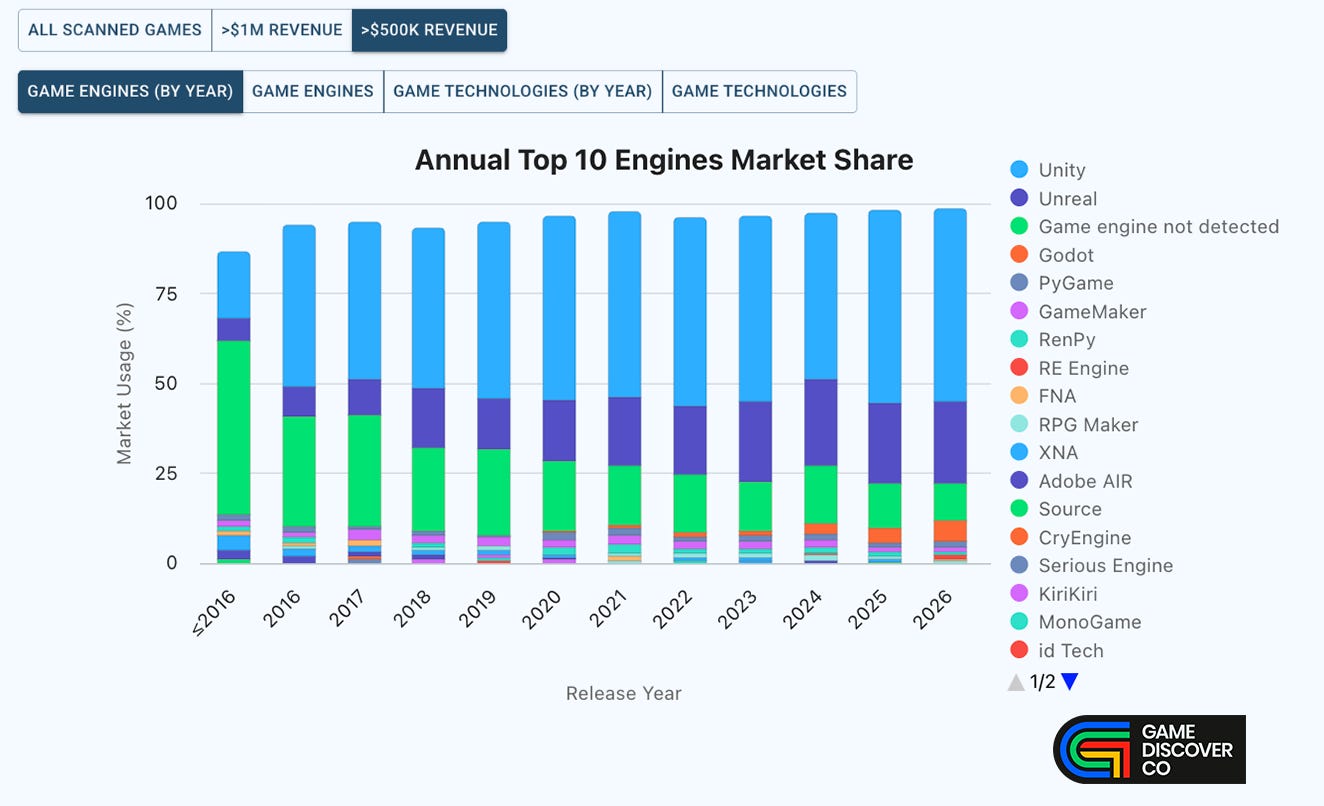
What we definitely notice in this >$500k bucket is an increase in Unreal’s market share by game from 20% (all games) to 22.5% (>$500k) in 2025. But we also see Unity increase even more, from 49.4% to 53.7%! Those with reduced share are Godot (down from 7.1% to 4.1%) and miscellaneous smaller engines.
What we find particularly intriguing in that context is that in the GDC ‘state of the game industry’ survey for 2026, 42% of devs said Unreal was their “primary engine for game development”, with Unity polling at 30%. (This survey likely skewed towards bigger, existing studios, and larger teams may have had multiple respondents.)
We haven’t modeled total market share by revenue yet. (We have the data to do so, and may present it when we do!) And it’s very difficult to measure how much a game cost, and therefore ROI. But one thing we’re noticing is more smaller Unity-powered titles having breakout hits - due to the sheer amount & the ease of getting games running.
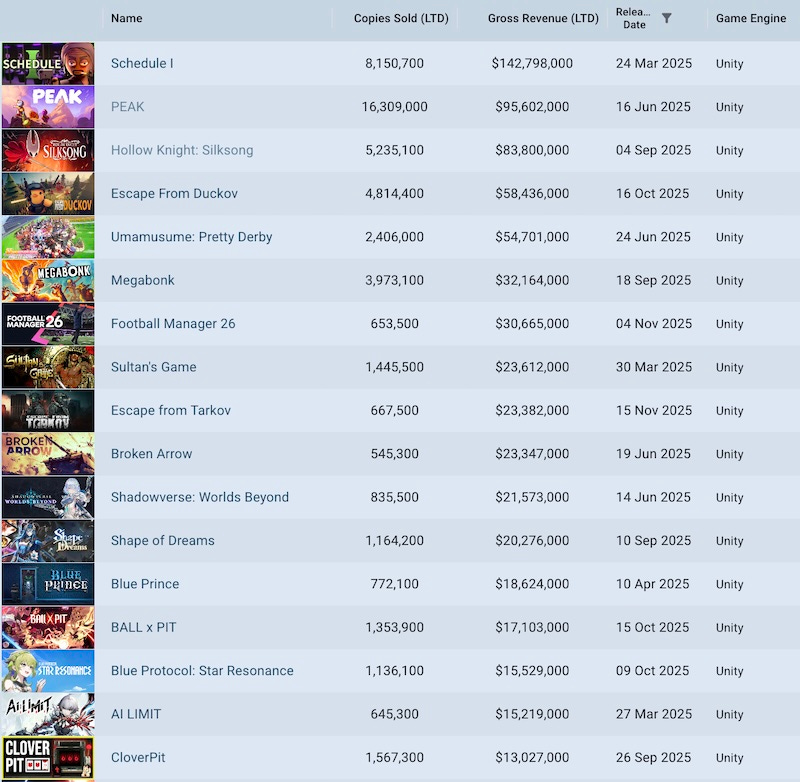
Almost 50% of the below top-charting new titles (listed by Steam revenue, launched in the last 12 months, Unity engine) are on the tinier team side of things, from Schedule I to Megabonk to CloverPit:
If you look at the same chart for Unreal-powered games (top new titles, last 12 months), we can only spot one game with a much smaller dev team - R V There Yet?, which is interesting, though the chart is higher-revenue in general:
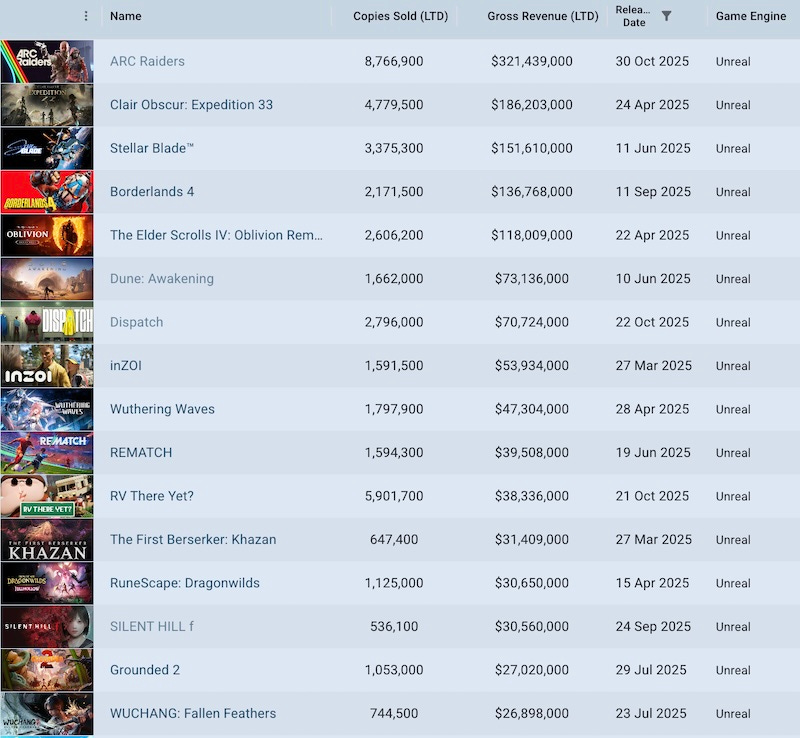
Perhaps this shouldn’t be surprising, with Epic keen to get smaller creators building Fortnite Islands as opposed to standalone PC games, and Unreal being known as a) a bit more complex b) good-looking on high-end consoles, also a target for above games.
As a final data anecdote, the Top 50 new Unreal games released in the last 12 month grossed ~$1.8 billion on Steam, and the Top 50 new Unity titles grossed ~$930m. What does that mean? Can we make it all make sense? (Editor: nope!)
Well it’s complex, since we’re pretty sure those Top 50 Unreal games cost much more than 2x those Unity ones to make. But we can generalize: Unity’s got the mass market Swiss Army Knife approach, Unreal’s a higher-end choice that larger teams often turn to, and Godot’s a scrappy newcomer that’s grabbed market share - but not theirs, yet.
Roblox’s top titles in February: Rivals hits top spot
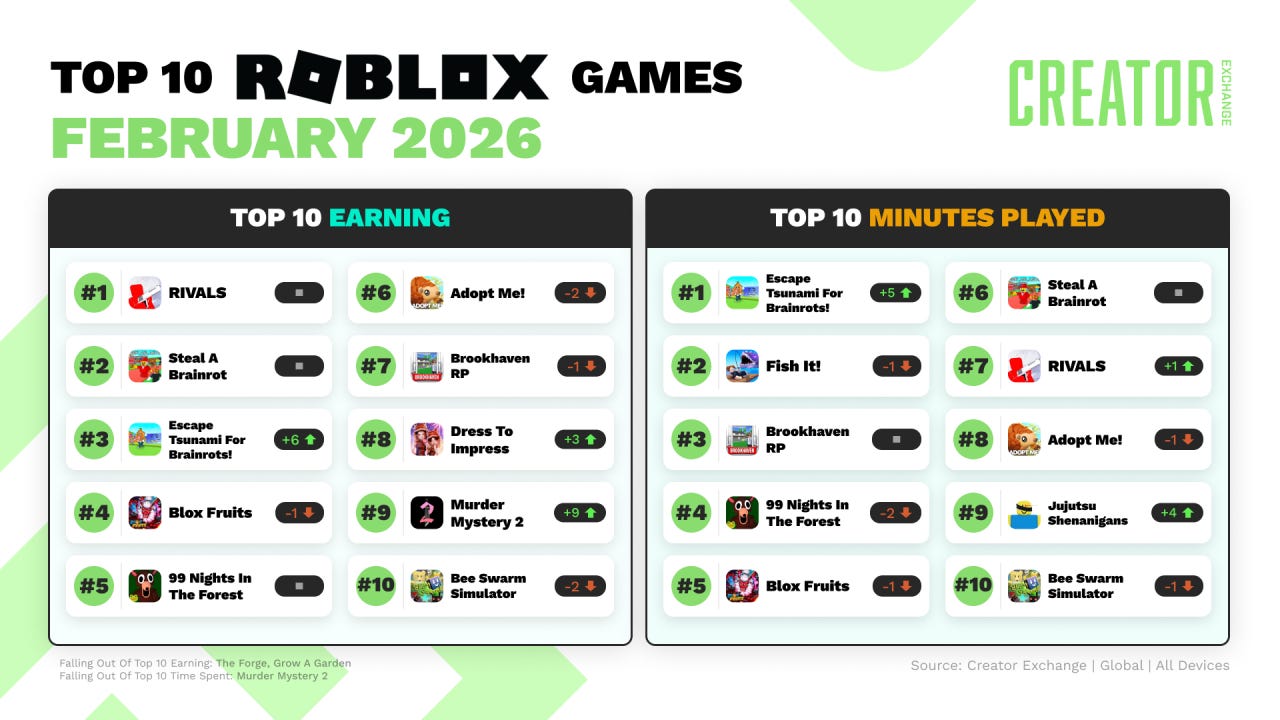
Finally, a swift look at February 2026’s top-earning Roblox charts (above), as worked out by David Taylor at Creator Games and Creator Exchange. Once again, we got a more detailed Top 20 (Google Drive doc) with average and peak CCU and average session length. But very briefly breaking this one down:
Roblox’s predominant shooter Rivals hit the top-earning spot: the PvP title, an intense 1v1 to 5v5 FPS, hit an average CCU of 298k, the lowest in the Top 5, but is on fire right now monetization-wise. (Check out someone hiring an in-game ‘sniper coach’ for their YouTube channel, to get an idea of the vibes.)
Escape Tsunami For Brainrots vaulted up to #1 in minutes played: we talked about this title last month. It’s brainrot-themed, with ‘avoid obstacles’ in a PvE environment, but has a collection mechanic. And man, Roblox players like collecting things. (Is this good? It’s what’s happening, anyhow.)
3D anime fighter Jujutsu Shenanigans hit Top 10 by minutes played: looking at YouTube videos of this one, it’s another of the ‘heavily unofficially inspired by an anime’ titles, with some interesting destructible environments and move sets, if all Roblox-coded. (It kinda looks fun, also.)
Well, I’ve comprehensively messed up my YouTube recommendations now, and am chagrined at my lack of Roblox expertise. But again - there’s a world out there that needs seriously looking at. Even Jujutsu Shenanigans is averaging 200k CCU across multi-platform Roblox players, for example - and that ain’t nothing. Toodles..
[We’re GameDiscoverCo, an analysis firm based around one simple issue: how do players find, buy and enjoy your PC or console game? We run the newsletter you’re reading, and provide real-time data services for publishers, funds, and other smart game industry folks.]