
[The GameDiscoverCo game discovery newsletter is written by ‘how people find your game’ expert & company founder Simon Carless, and is a regular look at how people discover and buy video games in the 2020s.]
We’re back, and time to look into a question that isn’t really discussed that much, partly because of lack of data: how old are people buying specific games on Steam, and does that make a difference to how we target them?
Before we start, here’s a super-original game merch idea: climbing game hit Cairn has a personalized ‘your ascent’ physical T-shirt, which “can only be ordered from within the game”, and shows your actual in-game route up the mountain on it. Clever, huh?
[THE DEEPEST PC/CONSOLE DATA? You can get a free demo of our GameDiscoverCo Pro company-wide ‘Steam deep dive’ & console data by reaching out today - >90 orgs have it. Or, signing up to GDCo Plus gets the rest of this newsletter and Discord access, plus more.]
Game discovery news: Warhammer skulls it up…
Let’s kick off the week with a few notable game platform & discovery links, as follows:
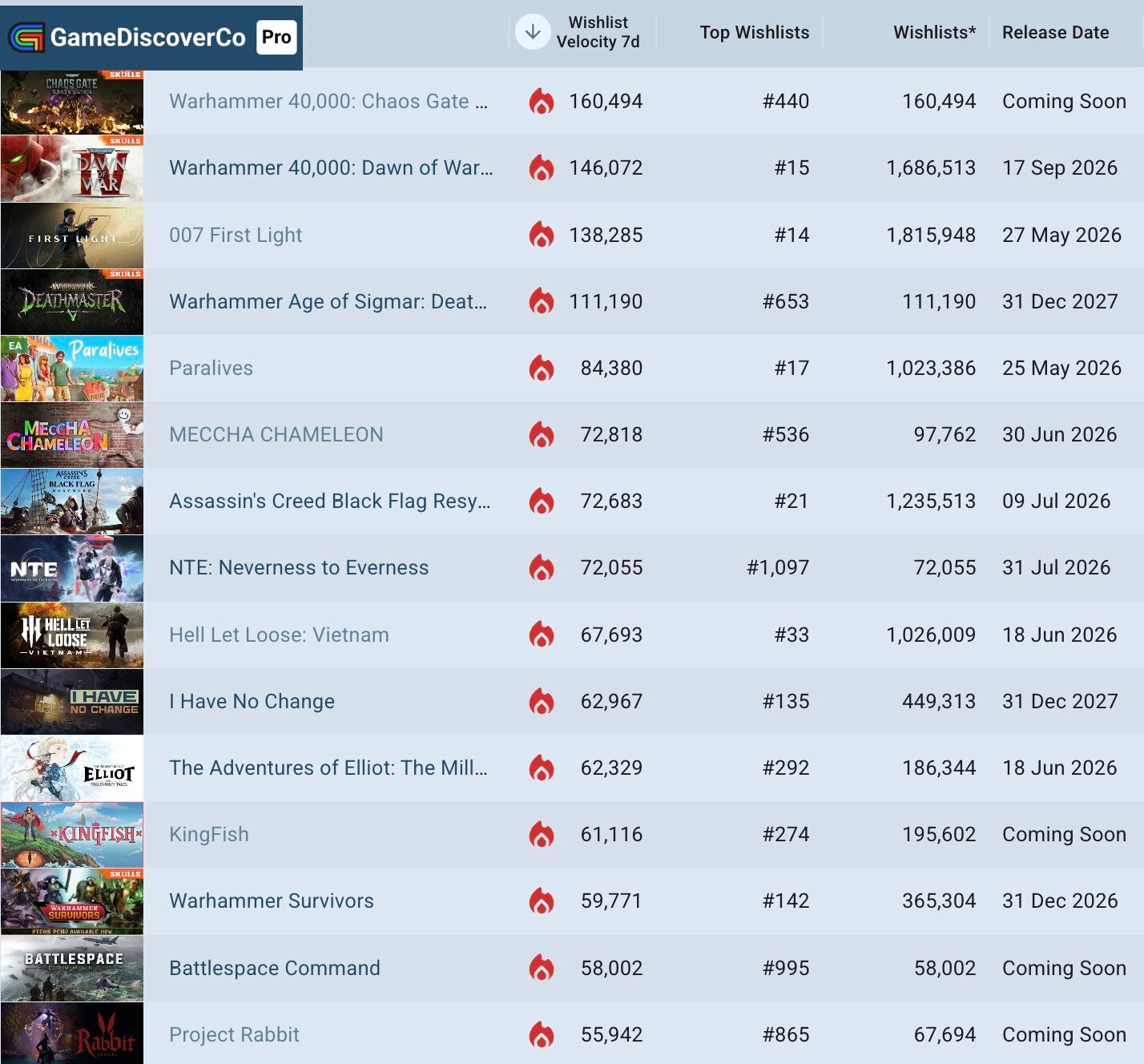
Here's GameDiscoverCo Pro's 'trending' unreleased Steam games, May 18th to 25th, as the Warhammer Skulls streaming showcase hyped 3 Warhammer titles: the new Chaos Gate turn-based tactics sequel (#1), pre-orders for RTS Dawn Of War IV (#2), and stealthy 2D platformer Age Of Sigmar: Deathmaster (#4).
This week's releases also hit big, with Bond-like 007: First Light (#2) due shortly and The Sims-like Paralives (#5) already out & hitting good CCU numbers. New? Mobile-to-PC F2P gacha Neverness To Everness (#8), military RTS Battlespace Command (#14) and Alice In Wonderland-themed Souls-like Project Rabbit (#15).
Take Two has some next-gen console totals in its financials, and it’s very unclear if Switch 2 is included or not (and there’s a weird decrease from last financials), but John Welfare guesses: “My take on 127M, IDG reports sell through and PS5 shipments were 92.1M 2025. Maybe they have ~90M PS5 and XBS would be ~37M.”
Folks in the GDCo Plus/Pro Discord spotted that Steam has added the ‘personal calendar’ feature to the homepage of the Steam client Beta. ICYMI, it’s this feature: upcoming games, inc. those you wishlisted, but also those wishlisted by “people with similar playtime profiles to you.” More good discovery!
Nick Heer wrote a good essay on ‘the metaverse fever dream’, explaining how far M. Zuckerberg (and M. Ball, atcheloi?) advanced the (non-achieved) concept of a singular shared digital reality, noting: “Many people - perhaps everyone, come to think of it - could predict the future if they got to retcon their predictions to fit reality.”
Engine news: the Unity Asset Store (and Fab.com’s Unreal marketplace) are vital force multipliers for those game engines’ success, it follows that Godot is introducing an official asset store. (Though it only permits add-ons to be listed for free for now.) Oh, Unreal Engine 6 got revealed as the next Rocket League engine.
A good view on Steam wishlist totals from randomly sampled Steam users via Ichiro Lambe (WeLoveIt): 36.2% have 1-10 games wishlisted, 45.5% have 11-100, 17% have 101-1,000, 1.3% have 1,001 to 10,000, and 0.1% (!) have more than 10,000. (Not sure if this tallies exactly with our samples, but it 100% makes sense…)
According to a new Bloomberg report: “Nintendo Co. has asked partners and suppliers to assemble about 20 million Switch 2 consoles in the year through March, roughly 20% more than the public sales outlook it issued earlier this month.” (Doesn’t mean it’ll sell that many, but always underpromise and overdeliver?)
Correction: we didn’t include the correct link to the Inside Games piece on best practices at physical game showcases in the last newsletter. (BONUS: don’t forget that Game Conference Guide has a giant list of game industry events, though it tends towards B2B rather than B2C.)
Microlinks: PlayStation Plus’ ‘monthly’ games for June are Xbox’s Grounded, plus Nickelodeon All-Star Brawl 2, & Warhammer 40,000: Darktide; Apple long-lists Inkle, Devolver, FuturLab, more in its annual design awards; Xbox “celebrates Global Accessibility Awareness Day with improved adaptive thumbstick toppers and more.”
OUR SPONSOR: FirstLook Agent - World’s First Games Marketing Copilot
What if you could just ask your player data anything? FirstLook Agent connects every wishlist, Discord thread, Steam review, and playtest session, then lets you chat with it like a teammate who's read everything.
Find players who demo'd for 10 hours but didn't buy. Cluster sentiment across reviews and surveys. Then tag the cohort, draft the email, push it live - all from the conversation. No dashboard hopping. Powered by Claude, Kimi, and Codex.
Currently free to use. Get started or book a demo to see it on your own playerbase.
Player age, and game discovery ramifications…
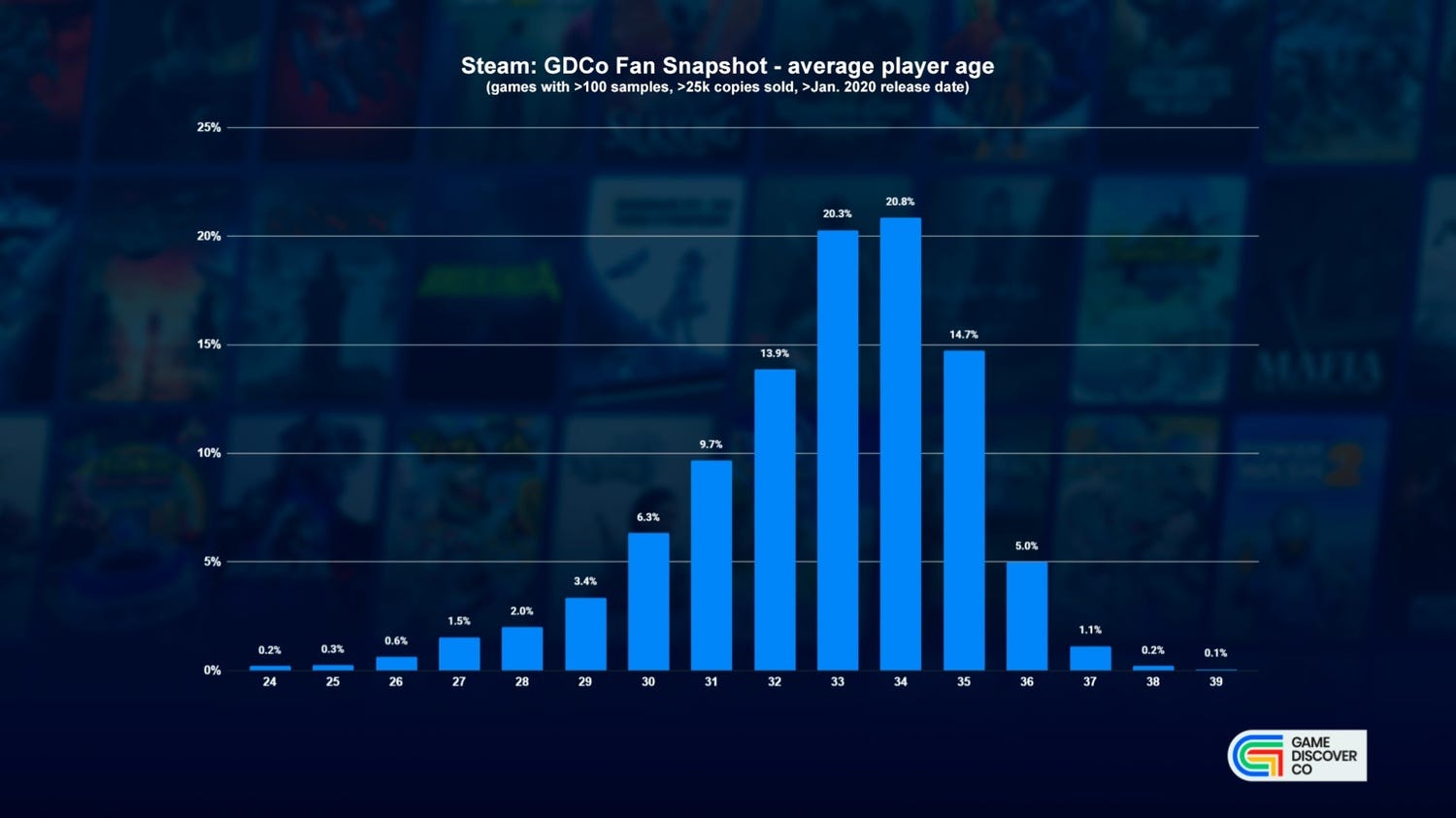
We announced our GDCo Pro Steam Fan Snapshot data early last month - reminder, it’s “a large, increasing survey of core Steam game fans, incenting players via giveaways & other methods”, with 10,000 players currently part of the sample. But we didn’t get much chance to go deeper into the data.
So we thought we’d look much deeper into one particular data point - average player age. Why? Because it’s a stat that really hasn’t been available for analysis, and we think it has some really interesting ramifications for how we all market games.
You can see our data above, sorted only for games with more than 100 player samples for games that released after Jan 1st. 2020 and have sold >25,000 Steam copies. Some key things to note:
Each data point in the above graph represents one game’s average player age: so when we list 0.2% of the games averaging 24, that includes a title like Five Nights At Freddy’s: Security Breach which has players both older and younger.
The median player age of our ‘Steam Fan Snapshot sample’ above is 33: we’re not claiming that’s the median age of all Steam players, but that’s the median of those games’ averages. (We suspect that would be late 20s, inc. more casual players.)
This year’s top-selling new games actually have decent-sized deviations: here’s the averages, as of last week: Slay the Spire 2 (29.7 years), Subnautica 2 (28.3), Resident Evil Requiem (30.3), Crimson Desert (31.3), Mewgenics (27.3), Windrose (33.4), Gamble With Your Friends (26.7), YAPYAP (26.5), Super Battle Golf (28.2).
While you may be ‘oh, a difference of 7 years isn’t a big deal’, and it’s also true that particular games may appeal to all ages, an ideal situation (!) But it’s good to look at the outliers and see what it says about different PC player demographics. First, here’s select games on the very high end of the ‘average age’ spectrum:
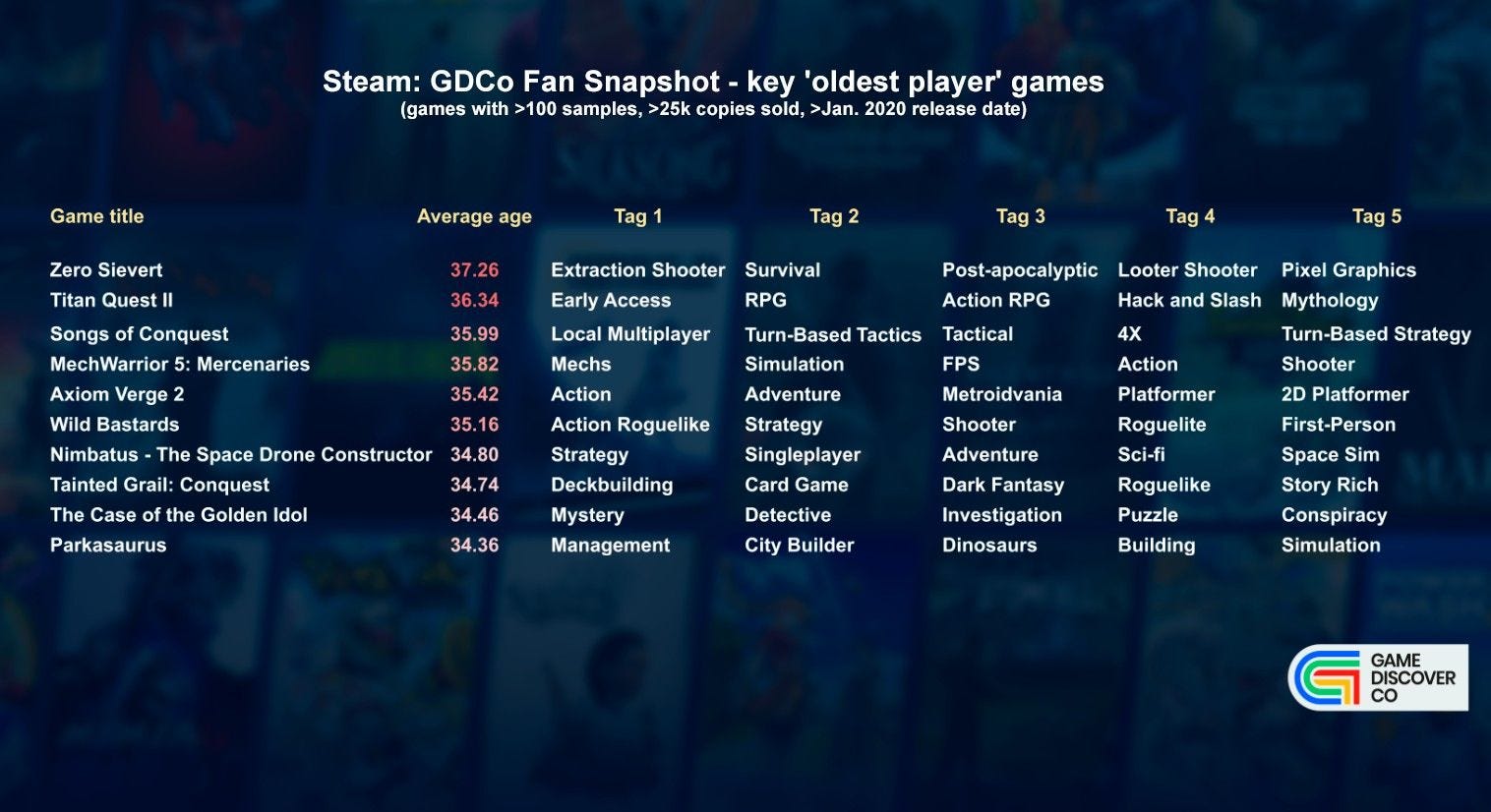
Is there any threads uniting these titles? Not exactly, but some things we noticed about them:
Many feel like ‘old school PC’-y games, with retro IP: franchises like Titan Quest and MechWarrior, the Heroes Of Might & Magic-inspired Songs Of Conquest.
Genres are strategy-first but not exclusively: including FPS (Wild Bastards) & sim (Parkasaurus), but also extraction & platformer (Zero Sievert, Axiom Verge 2).
Most of all, they’re singleplayer-first titles: none of the top 5 Steam tags for any of these games include online multiplayer or co-op.
Our view on this: there are genres and styles of game for people who have been playing PC games for 20-30 years. And most of these type of titles don’t appeal to younger players. (But they’ve all sold fairly well, so perhaps that’s just fine!)
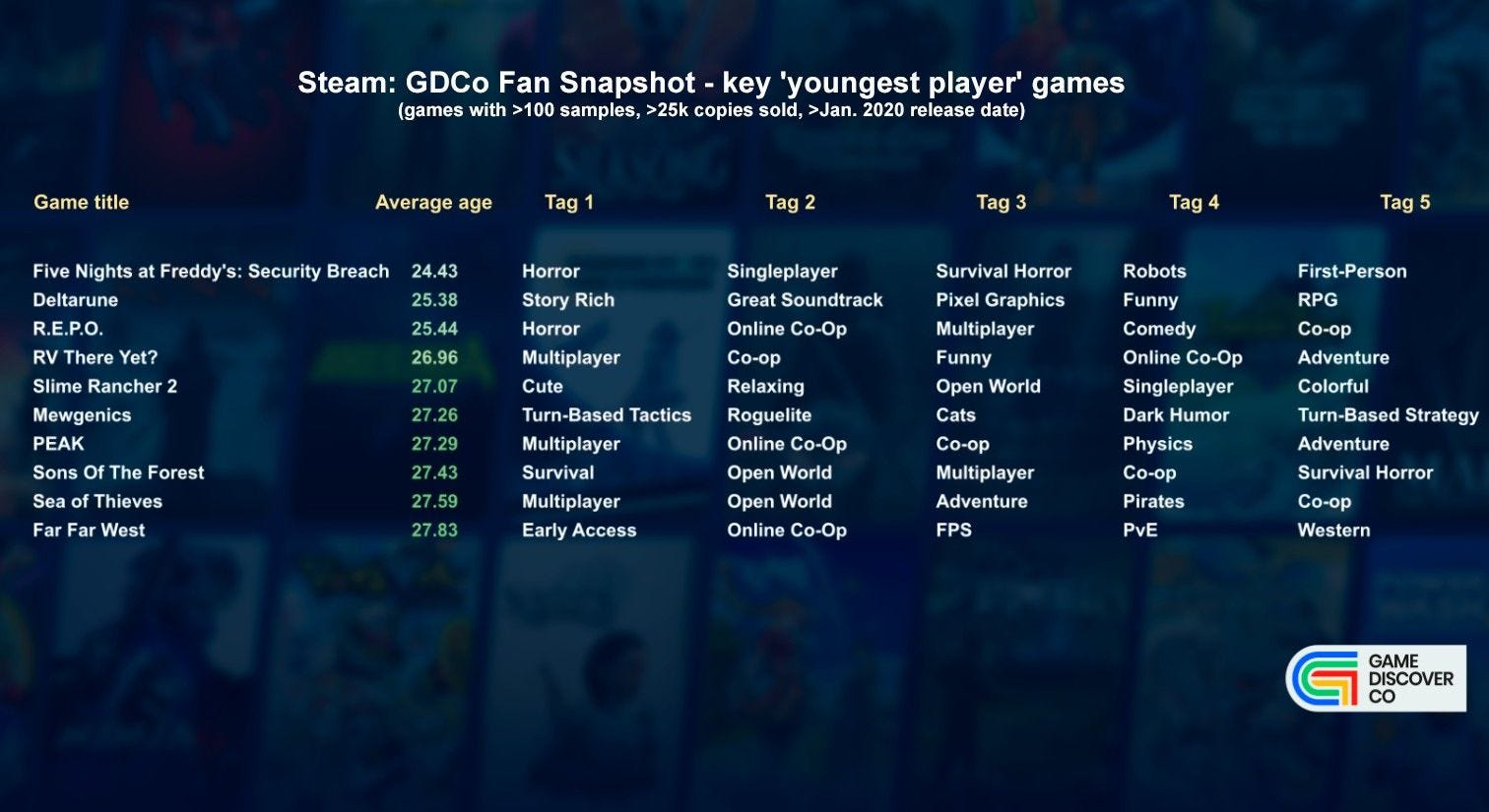
On to the much younger-average games - again, this is a sample of 10 titles picked from the lower end of the spectrum:
There sure is a lot of friendslop and co-op in here: some of these titles are newer, but you’re seeing big friendslop hits like R.E.P.O., RV There Yet? & Peak in here.
There’s also big ‘much-discussed on YouTube’ energy: titles like Five Nights At Freddy’s and Undertale follow-up Deltarune have big native fan communities.
More broadly, co-op games attract a younger demographic: younger digital natives hanging with their friends also play Far Far West & Sea Of Thieves.
In fact, Meta’s Chris Pruett talked at GDC 2026 about players graduating from social meme titles into “social, unpredictable, co-op” games with a bit more sophistication. I think we’re seeing evidence of that here - and that older players are less interested.
For anyone interested in combing into the ‘Top 5 tags’ evidence further, here’s a Google Drive document with the Steam tag breakdown per ‘average age’ - so you can look at how things change over time:

One example takeaway: games with an average age of 28 mention Multiplayer as a Top 5 tag 15 times, vs. only 3 times for Singleplayer. On the other hand, games with an average age of 36 mention Singleplayer 7 times and Multiplayer only 6.
And the 36-year old game cohort mentions Strategy a whopping 16 times, vs. once for the 28-year-olds. Similarly, horror or psychological horror? 13 times for the 28-year-old cohort vs. 4 times for the 36-year-olds.
There are also important ramifications for discovery methodologies - younger consumers rely way more on short-form video & word of mouth. We’ll delve deeper into this another time, but here’s all participants vs. R.E.P.O. vs ZERO Sievert on this:

So sure, some of this data is proving out ideas that you probably had already. But it’s important to understand the PC & console market as a series of overlapping filter bubbles & target and market appropriately. (It’s not just a monomarket out there!)
Using agents to analyze data - is it a good plan?
The idea for the above newsletter came from a prospective client discussion about how to target specific demographics. And what was interesting about it was that, for the second or third time recently, I suggested using GameDiscoverCo Pro’s MCP (Model Context Protocol) server to get some of the data. (Yes, this is an announce.)
So yep, much like today’s newsletter advertiser (hi, FirstLook!), we’ve been enabling agents like Claude to let our paid Pro users access our data via gated login, as an option. Why?
GameDiscoverCo has data that’s not always displayed in ways you need: for example, we have a one-by-one ‘compare’ screen for Steam Fan Snapshot, but no way to compare tens or hundreds of games easily in our interface.
Perhaps a natural language interface is easier for access: GDCo staffers know where our carefully made data submenus are for specific things. But the average user may not - why not ask an agent to grab & compile it for you? (We do have a GraphQL API for bulk requests, but much programming knowledge needed.)
Agents can include Steam web data dynamically: perhaps you want to take Steam forum sentiment into account in a query: we currently grab the # of Steam forum posts but not their sentiment. That’s something an agent could do. (You can also ask the agent not to include insight from sites that didn’t agree to it.)
I (Simon) personally don’t use agents, and exist in a bit of a filter bubble where my friends (with one exception, hi Keith!) don’t either. But I tried a couple of relevant searches using the GameDiscoverCo MCP, and wanted to show the results:
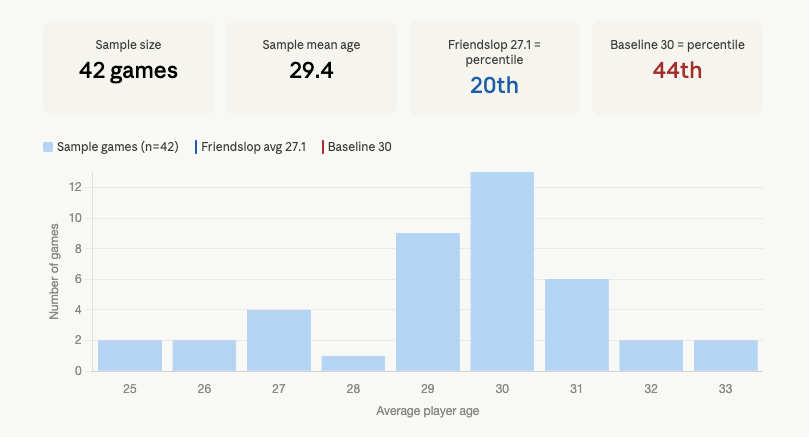
Asking about whether ‘friendslop’ games had below-average player age: Claude had to search and define friendslop titles, which is did 90% well (not sure about Among Us?), and ran into some kind of tech issue to initially display it. But the eventual result (above graph) using GDCo data was broadly factually correct.
Doing analysis on the top (& underperforming) releases of April 2026: the color analysis was pretty reasonable. Asking about under/overperformers was largely OK but a) it used current wishlists, not launch b) it thought 0.28x was an underperform, based on sampling top games. (That’s really a >2x overperform across all games.) Finding non converting high-wishlist games worked decently.
So what do we think? We like the agentic approach when it allows GDCo’s clients to collate data via API that they just couldn’t do via our interface, and ask more sophisticated cross-data questions. (We know of some folks doing complex revenue projection algorithms that way, to good success.)
Concluding: rather than a SaaSpocalypse, if you have unique data, agents may be a good alternative to access. But beware errant editorializing and content-’borrowing’ in ways that erodes the business of traditional content curators, as SparkToro just published a column about. (PSA: Pro users, look on the homepage for MCP info.)
[We’re GameDiscoverCo, an analysis firm based around one simple issue: how do players find, buy and enjoy your PC or console game? We run the newsletter you’re reading, and provide real-time data services for publishers, funds, and other smart game industry folks.]
People talk about gamers like it’s one audience when the discovery habits are completely different by age and genre
Thank you for linking, Simon :) It was a genuine pleasure to exchange few words at the GDC.