[The GameDiscoverCo game discovery newsletter is written by ‘how people find your game’ expert & company founder Simon Carless, and is a regular look at how people discover and buy video games in the 2020s.]
As we careen towards the end of the week, time to get back to game analysis, and we’re starting with complex artillery sim Iron Nest, which did a lot of things right along the way to 250k sales on Steam in 3 days. Wha? We’ll delve into that…
But before we start, we’ve been fascinated by Horse Magnifier: The Full Horse on Steam, an expanded version of an Itch x Godot jam game. What do you do? You have to use magnifying glasses to match up pixel-y horse pictures. (Only open game distribution platforms make the ‘horse magnifying’ oeuvre a possibility, folks…)
[DON’T HAVE OUR PRO DATA? You can get a free demo of our GameDiscoverCo Pro company-wide ‘Steam deep dive’ & console data, inc. MCP by reaching out today - >110 orgs have it. Or, signing up to GDCo Plus gets extra newsletter and Discord access, plus more.]
Game discovery news: some ‘above-par’ wishlists..
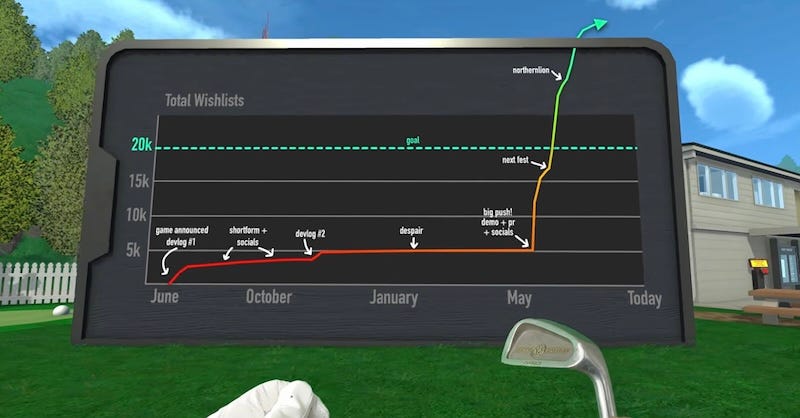
First, it’s time to trawl through some more discovery links - and platform ones - starting with the following:
Fruit Ninja creator Luke Muscat made a witty video about his offkilter title Normal Golf Game, with in-game illustration (above) of the game’s take-off to >40k Steam wishlists, thanks to a) shortform social media wins b) a Next Fest demo and c) a Northernlion video. It’s a fun watch…
Checking the top Steam demos launched in the last month for unreleased games, per GDCo, autobattler roguelite Guildrun (#1) still reigns, but PvE dungeon extraction looter Expedition: Into Darkness (#3) and It Works: Electronics Repair Simulator (#4) hang with adorable & chill sand(castle)box builder Sandcastle (#5).
You know how all big games are now platforms? Do Big Studios just “teamed up with PUBG Corporation to bring [Roblox megahit] Steal a Brainrot to PUBG’s new UGC platform, World of Wonder.” (It’s PUBG-ized in weird ways, but even more cross-game UGC ports are likely in the future…)
PlayStation just surprise dropped Helldivers 2 onto PlayStation Plus Game Catalog, about 2 and a half years after its OG debut. (So, a sensible interval, then!) Also out for PS+ Game Catalog now: Kingdom Come Deliverance II, Vampire Survivors, Hell is Us & more.
We don’t cover government subsidies for game dev much, but Chirag Vadhia just busted out a giant overview of them: “We looked at 79 listed games companies and 34 government schemes… in the accounts of those companies… dependence [runs] from a couple of points of profit at EA, to a credit worth more than the whole of Ubisoft’s.”
Microlinks: Footprints.gg’s latest ‘trad media’ references are dominated by GTA 6, thx to that upcoming Netflix reveal; using Valve’s Lepton Android translation layer, more former Quest exclusives like Action Hero are coming to Steam Frame; even former physical stalwart Capcom has 90% of its games bought digitally now.
Why are games like Call Of Duty trying to roll players into a ‘wrapper’ app across multiple franchise entries? So they can do things like pop-up pre-order ‘nags’ for Call Of Duty Modern Warfare 4 while you’re waiting for Call Of Duty Black Ops 7 to load, of course…
We dig some of the visualizations on Totally Human Media/Vaporlens’ new Steam revenue report - particularly the ‘Galaxy’ view. (But the less-accurate ‘copies sold = 35x reviews’ and ‘no discounts accounted for in revenue’ means you should look at the mass takeaways, not specific games’ estimates…)
Another vital (partially paywalled) Doug Shapiro mega-trends piece is on why “in recent years, almost all the value created in media has accrued to those who distribute content, not create or package it”, but “AI may partially uncouple distribution and coordination in media by introducing a new intermediary layer.”
What % of the first 30 days’ sales do each of the Polden Publishing games have every day? And what’s their 1 month to 3, 6 9, and 12 month multiples? Kirill Oreshkin was kind enough to lay it all out in black and white for us.
Microlinks: Stream Hatchet on battle royale’s live-streaming resurgence; Amazon Prime’s 9 ‘free’ games to keep for August include action RPG Steelrising; organic discovery differences between launching a free Android game in 2014 (13.6m downloads) & 2026 (single digit page visits, zero installs.)
OUR SPONSOR: The Expert Tool for Influencer Marketing
Time and preparation are crucial for planning your organic influencer marketing campaign. Starting right before an event or showcase by sending out keys and contacting a broad audience based only on email availability isn’t focused.
So we built a tool that lets you build a creator database customized for you.
Discover creators who play your kind of game.
Create and export creator lists based on your custom filters (and keys)
Track and share coverage reports
Stop looking for contact details manually and start focusing on your niche.
Ping Dennis if you’d like to learn more.
How Iron Nest Sold >250k PC copies in <3 days…
If you’re paying attention, you may have spotted that “brutal dieselpunk heavy-artillery game” Iron Nest ($20, launch discount to $15), created by Nick (Niewoudt) Talmers & Dominik Latos, just had a spectacular launch on Steam, hitting >250,000 copies sold in less than 3 days, and cresting at 17,500 concurrents on the service.
We’ve been following this game for some time. It made GDCo’s ‘trending wishlists’ charts, and its demo was a break-out hit at June 2026’s Next Fest, ranking #2 on Steam’s most-played demo list. Courtesy of the devs, here’s their daily Steam wishlist chart leading up to release:
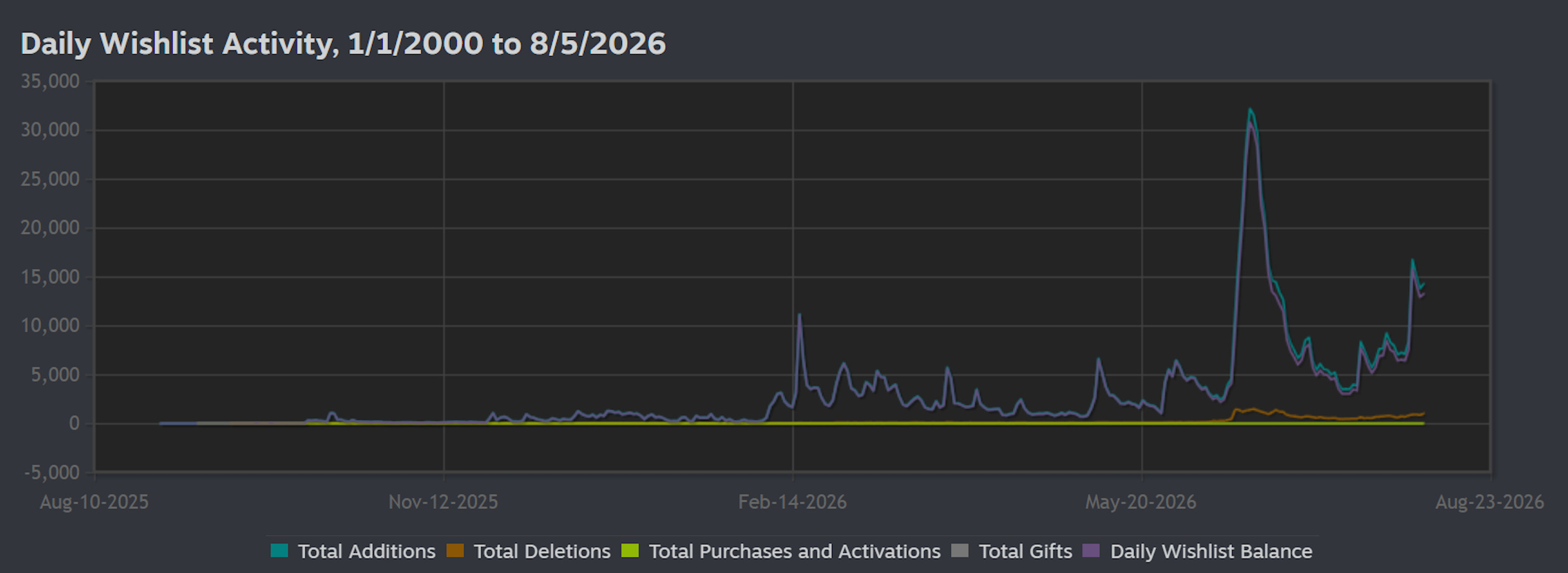
The giant spike here is obviously Steam Next Fest, where they tell us >700,000 people played the demo. (The demo now sits at 876,000 players, with an impressive median play time of 2 hours and 19 minutes.) But with >400k wishlists even pre-demo, a lot of the initial WL spikes were short-form video ‘hits’, many organic and third-party…
We asked Dominik about how important short-form was, and he said: “Short-form videos were the first pieces of content that really started to go viral in certain places and gave Iron Nest that initial traction… [but] the closer we got to launch, and the more marketing beats we introduced - playtests, the demo, Next Fest, and so on - the more other formats [like horizontal video, Reddit & others] started becoming equally important.”
Just finishing out the data dump courtesy of the devs, Iron Nest (as of August 11th, 5 days after release) actually hit >365k copies sold and $4.7m gross, with a paltry 4% player refund rate (significantly below average):
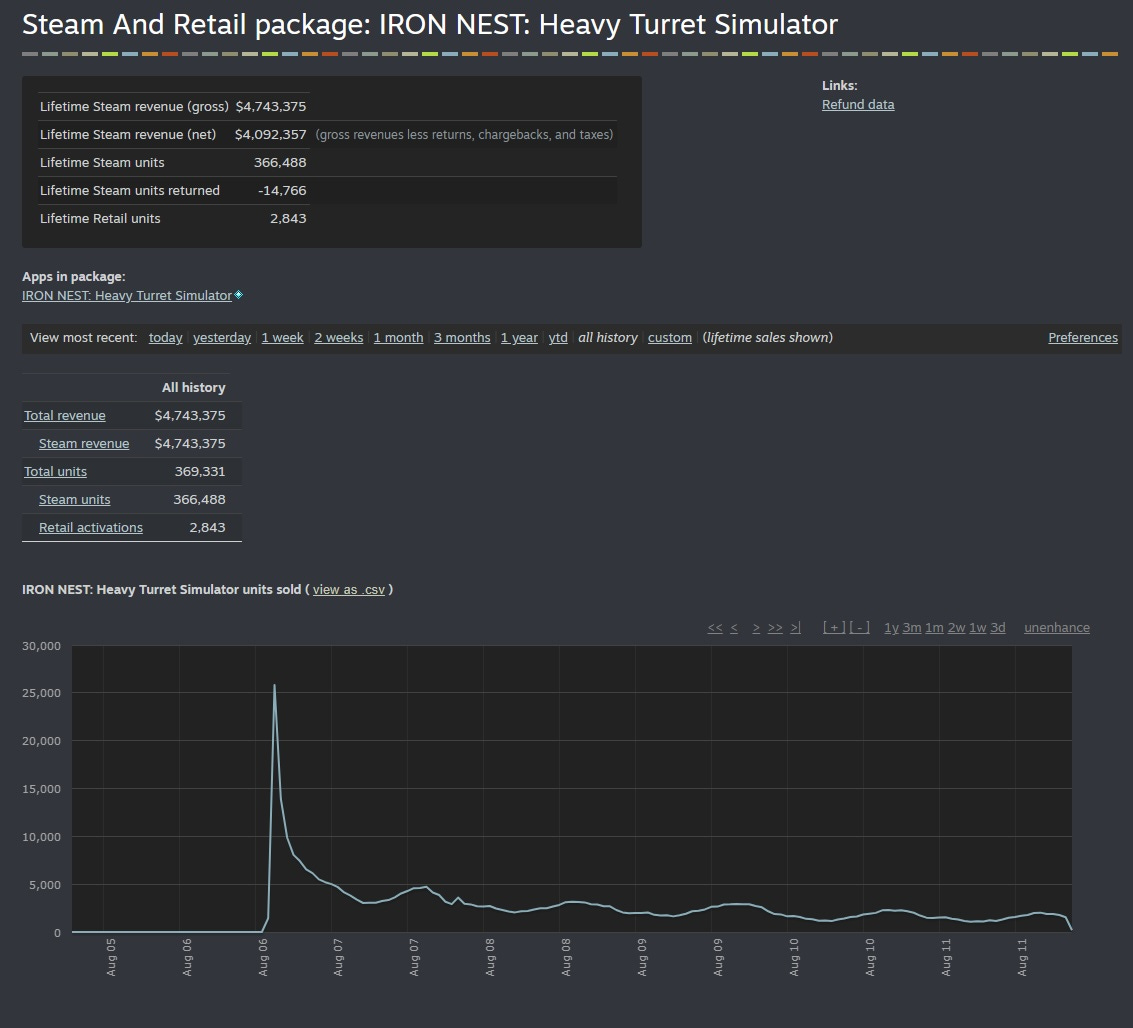
Oh, and for the record, 29% of the buyers of this game were U.S., followed by China (10%), Germany (8%), the Russian Federation and the UK (5% each), Canada (4%), and France, Australia, Ukraine and Poland (3% each). (That’s expected-ish, with a bit of an Eastern European skew in places?)
What type of people are core fans of this game? We took a quick look in GDCo Pro at games that public players of Iron Nest have played more often than the median Steam user (high affinity mult!), and came up with a lot of high-tech, military-coded games:
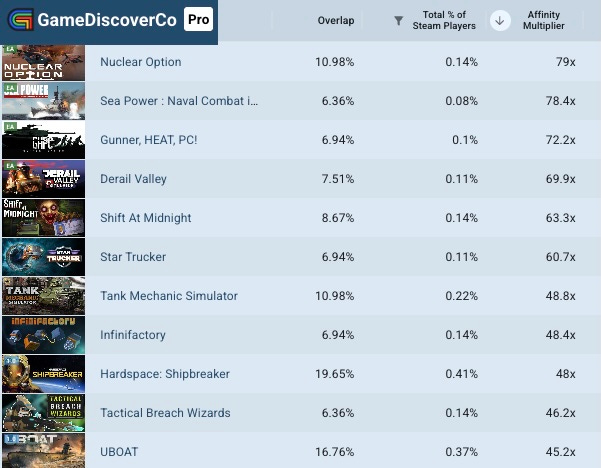
Anyhow, if you look at our estimated ‘long tail’ multipliers, we’d expect this game to sell a million copies on Steam somewhere close to the ‘1 year after release’ mark (or earlier, possibly), and eventually gross $10-$15m+. Not bad for a two-person game that took just over a year to make, hm?
So that’s the results. Now, we’re going to talk about why the game has resonated so well, both in idea and execution, and end with a major question (caveat? conundrum?):
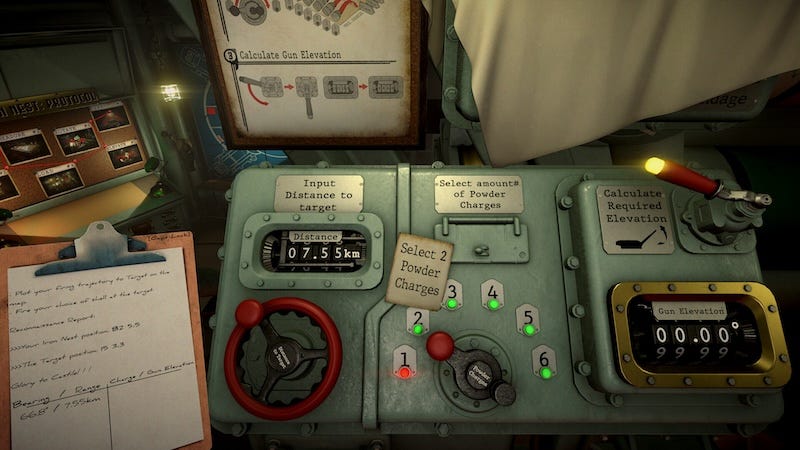
Hook-wise, this type of ticky-tacky mechanical design is irresistible: look at all the gorgeous retro buttons & knobs. Don’t you want to push them all and see what they do? That’s a big key to its wishlist success - fulfilling dev Nick’s core fantasy, which is “operating from inside a battleship-esque turret” with “complex mechanical animations, sound design, atmosphere, and environmental design.”
The actual gameplay was put together smartly and analytically: the meat of the game is around getting orders, manually plotting and triangulating firing locations and distances, and then adjusting levers. As Nick notes, it’s all about making “gameplay puzzles you [are[ solving using the turret.”
Incremental, but interesting mission design in a self-contained space: A bit like a stage play set on one single set, because the game had a short dev time, it needed “a polished environment that had a lot of variety and replayability in the missions themselves, but without requiring any changes or additions to the environment.”
To give you a basic idea of why people dig Iron Nest, here’s one of the top-rated Steam player reviews: “This game is the poster child for good sound design. The deafening shots and every metallic creak make the Iron Nest feel incredible. Overall it scratches a very specific itch if you love big machinery and doing repetitive procedures efficiently. As the levels go on, you learn new ways to triangulate and you get your own workflow that feels really good.”
But to end, we do have to address the elephant in the room - a little game called PVKK: Planetenverteidigungskanonenkommandant, from the devs of Dome Keeper, which was announced in June 2024, and is now due out in 2027:
This game has the same ‘main’ hooks that Iron Nest does - controlling a large gun within a confined space where you manually manipulate controls. And to give them credit, the Iron Nest devs are clear throughout that they’re quite inspired by PVKK, though they also try to explain differences in a devlog:
“We both have big cannons? Sure... We both have fully manual control? Absolutely... But what you do with the cannon in IRON NEST is entirely different! We're huge fans of PVKK and, YES - it definitely inspired us. But our core gameplay loop revolves around ground-based artillery, which brings a completely different setup, mechanics, and challenges compared to an orbital gun!”
‘Completely different?’ Well… possibly not. I’ve actually been back and forth about how to feature Iron Nest because of this. But in the end: it’s the year 2026, and if your initial trailer >two years ago invented a new microgenre (‘small room x machinery x firing sim’), PVKK should probably expect other people to riff on the same concept*. This is an argument to prioritize ‘shipping speed’ after showcasing unique ideas.
(*I would have preferred it to be a more abstract riff, such as ‘torpedos in a submarine’, but you can’t deny that Iron Nest did a bang-up job of a more limited-scope, focused take on the idea, and def. has its own takes on art direction & atmosphere.)
It’s clear that players don’t mind, while understanding PVKK “seems to have a much stronger narrative and thematic campaign.” Many have also wishlisted PVKK - 26% of current Iron Nest wishlisters, according to GDCo Pro. And to end, here’s the reaction to both games existing on the PVKK subReddit, which seems… good for all parties:

This week on Steam: Vietnam, Servant, Sandustry..